Why Most Kids' Room Systems Fail
Parents often design children's storage the same way they organize their own spaces - with labeled drawers, sub-categories, and a logical hierarchy that makes complete sense to an adult. The problem is that most children, especially under age eight, don't sort by category instinctively. They sort by what fits and what's closest. When the system doesn't match how they actually think and move, it gets abandoned within a week.
The most durable systems are ones children can operate independently, without coaching. That means every element - the height of a shelf, the openness of a bin, the size of a label - needs to account for the child's age and physical ability. For a broader view of how room-by-room thinking applies across the whole home, see our complete home organization framework.
Age Makes a Significant Difference
A system that works well for an eight-year-old may be frustrating or confusing for a three-year-old. As a general guide: toddlers need open bins with picture labels and minimal categories; early elementary-age children can handle more categories and some word labels; tweens can manage divided drawers, checklists, and more personal responsibility. Adjust expectations and structure to match your child's current developmental stage, not the stage you'd like them to be at.
Design Storage at the Child's Level
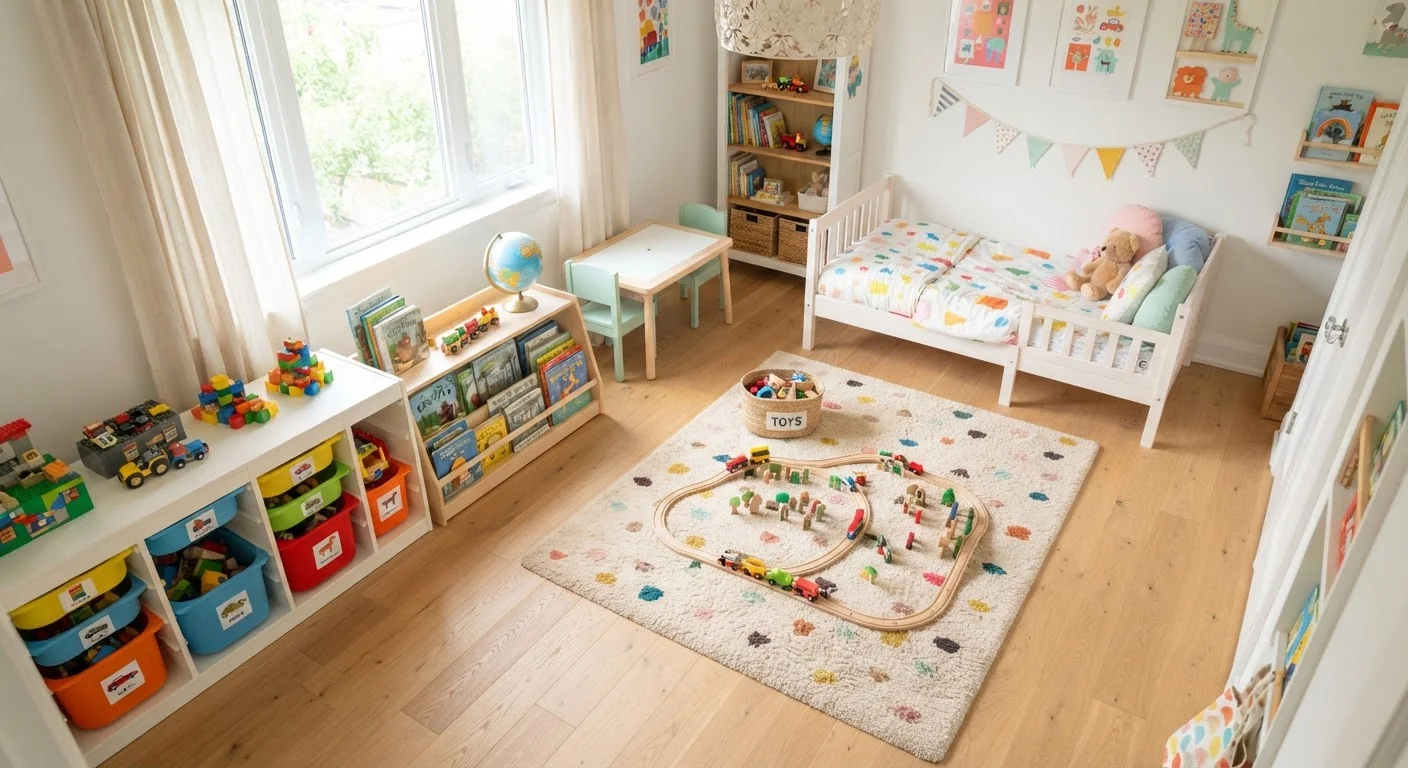
The single most effective structural change you can make is placing storage below the child's shoulder height. When bins and shelves are reachable without help, children are far more likely to put things away on their own. Wall-mounted solutions can work well for older children, but for toddlers and early elementary-age kids, floor-level and low-shelf storage is almost always the right call.
Open-top bins beat closed drawers for younger children because there's no lid to lift and no handle to pull - items just get dropped in. Broad, shallow containers also outperform deep ones; a deep bin turns into a catch-all where nothing gets found. Our guide on vertical versus horizontal storage strategies can help you decide which approach suits the room's layout best.
Use picture labels for children under six, word labels for older kids
Young children are pre-readers or early readers - written labels offer no guidance if a child can't decode them. Picture labels make categories immediately recognizable and independent to use. As reading fluency grows, word labels reinforce literacy while keeping the system functional.
Limit each bin to one broad category, not multiple narrow ones
Over-categorization creates decision fatigue for children. When a child has to decide whether a dinosaur goes in the 'small figures' bin or the 'animals' bin, they're likely to leave it on the floor instead. Broader categories - 'things that build,' 'things with wheels,' 'soft toys' - reduce friction dramatically.
Place the most-used items at the easiest access point
Accessibility drives behavior. If the items a child reaches for a dozen times a day require effort to retrieve or return, they'll end up permanently out of place. High-use items belong at the front, at eye level, and in open containers.
Designate a 'landing zone' for in-progress projects
Children often abandon systems because they have no way to pause a project without dismantling it. A dedicated tray, shelf, or corner for works-in-progress removes the all-or-nothing pressure of full cleanup and keeps active play from spreading throughout the room.
Involve the child in setting up the system from the start
Children are significantly more likely to maintain systems they helped create. Ownership isn't just psychological - it also means the child understands the logic of where things go, rather than just being told. Participation turns compliance into investment.
Reduce Before You Organize
No storage system can compensate for too much stuff. Before placing a single bin, do a realistic edit of what's actually used. A useful rule of thumb is to keep only what fits comfortably in the available storage - if it doesn't fit without forcing, there's too much. Rotating toys in and out of a closet or storage area (rather than keeping everything accessible at once) reduces visual clutter and often increases how much a child engages with what's available.
Involve your child in this step, age-appropriately. A five-year-old can identify toys they don't play with anymore; a ten-year-old can take more ownership of deciding what stays. This isn't just practical - it builds the habit of evaluating possessions rather than accumulating them passively.
Build Routines Around the System
Physical storage is only half the equation. A daily routine anchors the system in habit. For most families, a short tidy-up window before dinner or before bed - five to ten minutes - is more sustainable than expecting continuous tidiness throughout the day. The goal isn't a perfect room; it's a consistent reset that prevents buildup.
Make the routine concrete and time-limited. Using a visual timer helps children understand the expectation has an end point. Younger children do better with a parent present for the first few weeks until the habit forms. Older children can often manage independently once the system is intuitive.
If your household includes children with different tidiness tendencies - or you share the space with a partner who has different standards - the strategies in organizing shared spaces with different standards apply directly here.
“The environment should be organized so that children can do things for themselves. When children can access and care for their own materials, they develop independence alongside tidiness.”
— Maria Montessori, Educator and founder of the Montessori method of education
Adjust the System as Children Grow
A system that works at age four will likely need rethinking at age eight, and again at twelve. As children develop, their organizational capacity grows - they can handle more categories, more abstract labels, and more responsibility for the overall state of their space. Revisit the room's setup at least once a year, ideally at a natural transition point like a new school year or after a birthday when new items arrive.
The shift from picture labels to word labels, from open bins to divided drawers, from parent-guided tidying to fully independent upkeep - these are milestones worth planning for rather than reacting to. A system that adapts with the child is one that remains usable rather than becoming a source of friction.
For rooms where floor space is limited, the principles in small-space storage solutions offer practical ways to maximize every square foot without overwhelming a child's ability to maintain order.
40%
Reduction in household clutter through toy rotation
Child development researchers and professional organizers widely cite toy rotation as one of the most effective methods for reducing perceived clutter and increasing children's engagement with available items.
5-10 min
Daily tidy time that sustains most children's rooms
Occupational therapists and family organization specialists generally recommend brief, consistent reset windows rather than longer infrequent cleanups for maintaining children's spaces.