
Why 5G Marketing Outpaces Reality
Carrier advertisements paint 5G as a universal, transformative upgrade available nearly everywhere. In practice, the experience is far more variable. The gap between coverage map claims and on-the-ground performance comes down to how carriers define "coverage," what spectrum bands are actually transmitting in a given area, and how building materials, terrain, and network congestion affect the signal that reaches your device.
Understanding what 5G actually is - and isn't - helps you make smarter decisions about phone upgrades, data plans, and realistic expectations. For a parallel look at how marketing can outpace reality in broadband, see our guide to home internet speed myths.
Myth
If my carrier's map shows 5G in my area, I'll get fast 5G speeds.
Fact
Coverage maps indicate signal presence, not speed tier. Low-band 5G can appear identical to high-speed coverage on a map while delivering only modest gains over 4G LTE.
Carriers use color-coded maps that typically don't distinguish between spectrum bands. A shaded region may represent low-band 5G that reaches far but delivers median download speeds in the 50-150 Mbps range - similar to solid LTE performance. Only mid-band and mmWave deployments produce the dramatic speed jumps featured in commercials. Always look for band-specific details or secondary map layers, if the carrier provides them.
Myth
5G will replace home broadband for most households.
Fact
Fixed wireless 5G internet is a viable option in some areas, but it currently cannot match the consistency and capacity of fiber or high-tier cable for typical household use.
Fixed wireless access (FWA) using 5G has expanded meaningfully, particularly in suburbs and smaller markets underserved by wired broadband. However, shared spectrum, variable congestion, and weather sensitivity - especially with mmWave - mean that performance can fluctuate in ways that dedicated wired connections do not. For households with multiple simultaneous users, video calls, and gaming, wired broadband generally provides more predictable throughput.
Myth
Buying a 5G phone means you're automatically on 5G.
Fact
A 5G-capable device only connects to 5G where the network exists, where your plan supports it, and where your phone's supported bands align with what the local tower broadcasts.
Device compatibility, plan tier, and local network deployment all have to align. Some entry-level 5G phones support only certain band combinations, which may not match the mid-band frequencies a carrier uses in a given city. Additionally, in areas without 5G infrastructure, a 5G phone defaults to 4G LTE - which is still a capable, widely available standard for most everyday mobile tasks.
Myth
5G signals penetrate buildings just as well as 4G.
Fact
Higher-frequency 5G bands, particularly mmWave, have significantly reduced building penetration compared to 4G LTE and low-band 5G.
The physics of radio frequency means that higher frequencies carry more data but travel shorter distances and struggle with obstacles. mmWave 5G can be blocked by glass, concrete, and even the human body. This is why mmWave deployments are concentrated outdoors in dense public spaces rather than serving as general indoor coverage. Low-band 5G behaves more like existing 4G in terms of penetration, but without the speed advantages of higher bands.
Myth
5G is only useful for downloading faster - it doesn't affect everyday tasks.
Fact
Reduced latency, a key 5G improvement, can meaningfully improve real-time applications like video calls, cloud gaming, and connected device responsiveness.
Latency - the delay between sending a request and receiving a response - can drop substantially on mid-band 5G compared to 4G LTE. For tasks like interactive video conferencing, responsive navigation apps, or streaming with minimal buffering, lower latency matters independently of raw download speed. The practical benefit grows as more applications are designed to take advantage of it, including capabilities relevant to connected devices like wearables and smart home sensors.
The Three Bands Behind the 5G Label
Not all 5G is built the same. Carriers deploy 5G across three spectrum categories, each with distinct trade-offs:
- Low-band 5G (sub-1 GHz): Wide coverage, excellent building penetration, but speeds often only modestly faster than advanced 4G LTE. This is what fills large geographic areas on coverage maps.
- Mid-band 5G (1-6 GHz): The practical sweet spot - meaningfully faster than 4G, with reasonable range and indoor reach. Most urban and growing suburban 5G falls here.
- mmWave (millimeter wave, 24-47 GHz): Capable of multi-gigabit speeds but limited to very short distances, blocked by walls, windows, and even heavy rain. Deployed mainly in dense urban venues like stadiums and transit hubs.
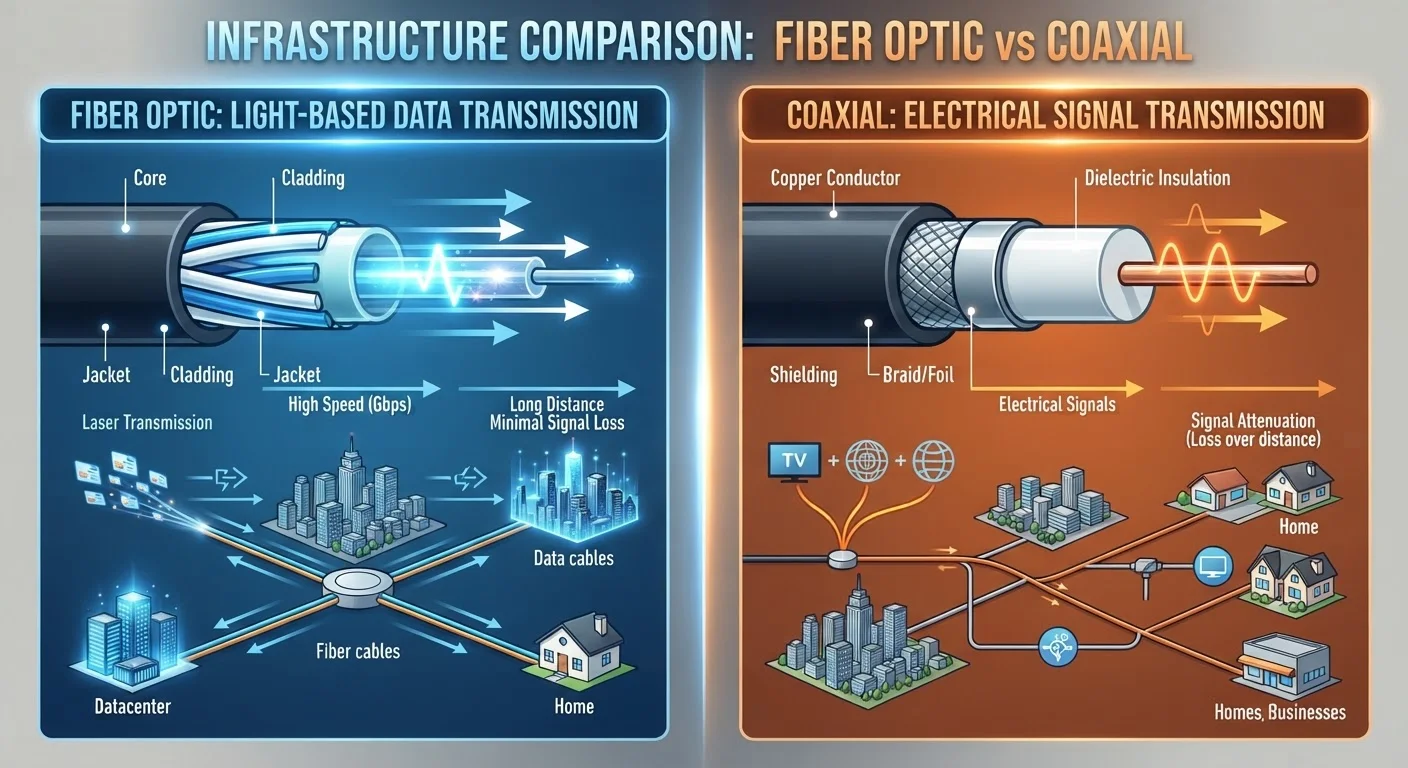
When a carrier's map shows your neighborhood in color, it may be low-band coverage delivering speeds comparable to a strong LTE connection - not the gigabit experience the ads imply. To understand how these wireless speeds compare to home broadband, our fiber vs. cable internet explainer offers useful context.
~30%
U.S. geography with mid-band 5G access
Industry analyst estimates suggest mid-band 5G - the tier most likely to deliver substantially faster speeds - reaches a far smaller geographic footprint than total 5G coverage claims suggest.
50-250 Mbps
Typical low-band 5G median download range
Independent network testing organizations have consistently measured low-band 5G median speeds in this range - comparable to strong 4G LTE performance rather than the gigabit figures in carrier advertising.
What This Means for Your Decisions
Before upgrading your phone or switching plans specifically for 5G, it's worth checking which band type is actually deployed in the areas you use most. A 5G phone in a low-band-only zone may deliver a nearly identical experience to the 4G LTE device it replaced.
Coverage Maps Are a Starting Point, Not a Guarantee
Carrier coverage maps are self-reported and use methodologies that vary between providers, making direct comparisons difficult. Signal strength, indoor availability, and actual throughput at a specific address can differ significantly from what a map suggests. Before committing to a new plan or device specifically for 5G, consider checking independent network testing data or using a trial period your carrier may offer.
Coverage checkers on carrier websites typically distinguish between "5G" and "5G Ultra" (or equivalent branding) to indicate mmWave zones - though terminology varies. Third-party tools and crowd-sourced signal databases can supplement official maps with more granular, real-world data. Understanding plan terms like deprioritization and throttling is equally important; our mobile data plans explainer breaks those down in plain language. And if you're already experiencing patchy signal, the causes are often geographic and structural - explored in detail in our article on why phone signal drops in certain spots.
5G is a genuine generational improvement in wireless technology - but its full benefits are unevenly distributed and still maturing. Matching your expectations to what's actually deployed where you live and work is the most practical starting point.