Why Protocol Choice Matters
When you add a smart bulb, thermostat, or doorbell camera to your home, you might assume they all connect the same way your laptop does - over Wi-Fi. In reality, many smart devices communicate using entirely different wireless protocols, each designed with specific trade-offs in mind. Choosing devices that use incompatible protocols can lead to reliability problems, hub requirements, or a setup that's harder to expand. Understanding what's under the hood helps you make more intentional decisions. For a broader look at how these devices fit together, see our article on how smart home ecosystems work.
Wi-Fi: Familiar but Resource-Heavy
Wi-Fi is the protocol most consumers already know. Smart devices using Wi-Fi connect directly to your home router without a separate hub, which makes initial setup straightforward. That convenience comes with trade-offs: Wi-Fi devices draw comparatively more power (problematic for battery-operated sensors), and each device adds to your router's client count - a real concern in larger homes with dozens of gadgets.
Wi-Fi works best for bandwidth-hungry devices like security cameras, video doorbells, and smart displays that need to stream data continuously. It operates on the 2.4 GHz or 5 GHz bands, with 2.4 GHz offering longer range and better wall penetration at slower speeds. If your home network is already under strain, adding many Wi-Fi smart devices can degrade overall performance. Our guide on home network security practices covers how to keep a busy network better organized and protected.
| Wi-Fi | Zigbee | Z-Wave | Thread | |
|---|---|---|---|---|
| Frequency Band | 2.4 / 5 GHz | 2.4 GHz | ~908 MHz (US) | 2.4 GHz |
| Network Type | Star (router-centric) | Mesh | Mesh | Mesh (IP-based) |
| Power Consumption | High | Low | Low | Very low |
| Hub Required | No | Yes | Yes | Border router needed |
| Device Capacity | Dozens (router limit) | Hundreds | 232 devices max | Hundreds |
| Interoperability | Varies by platform | Moderate | High (Z-Wave Alliance) | High (via Matter) |
| Best Use Case | Cameras, displays | Sensors, lighting | Locks, sensors | Mixed low-power devices |
Zigbee and Z-Wave: Mesh Protocols Built for Smart Homes
Zigbee and Z-Wave were designed specifically for smart home and IoT (Internet of Things) applications. Both create mesh networks - each powered device on the network can relay signals from others, extending range and improving reliability. They also consume significantly less power than Wi-Fi, making them well-suited to battery-powered devices like door sensors, motion detectors, and smart locks.
Zigbee operates on the 2.4 GHz band (the same frequency as Wi-Fi and Bluetooth), which can occasionally cause interference. It supports large networks - theoretically hundreds of devices - and is widely used by major smart home platforms. Z-Wave runs on a dedicated sub-gigahertz frequency (around 908 MHz in the U.S.), which avoids Wi-Fi congestion entirely and offers slightly longer range through walls. Z-Wave also enforces stricter interoperability standards among manufacturers, which can mean more predictable device compatibility. Both protocols typically require a compatible hub or controller to connect to your broader home network.
Mix Protocols Strategically
Most experienced smart home setups use more than one protocol. A common approach is using Wi-Fi for cameras and streaming devices, while relying on Zigbee or Z-Wave for sensors, switches, and locks. Many multi-protocol hubs support this combination out of the box, letting you choose the right tool for each device type without being locked into a single standard.
Thread: The Newest Contender
Thread is a newer mesh protocol that combines many of the power-efficiency benefits of Zigbee and Z-Wave with a key architectural difference: it is built on IP (Internet Protocol), the same foundational technology as the internet itself. This means Thread devices can communicate more directly with other IP-based systems without translation layers, reducing latency and complexity.
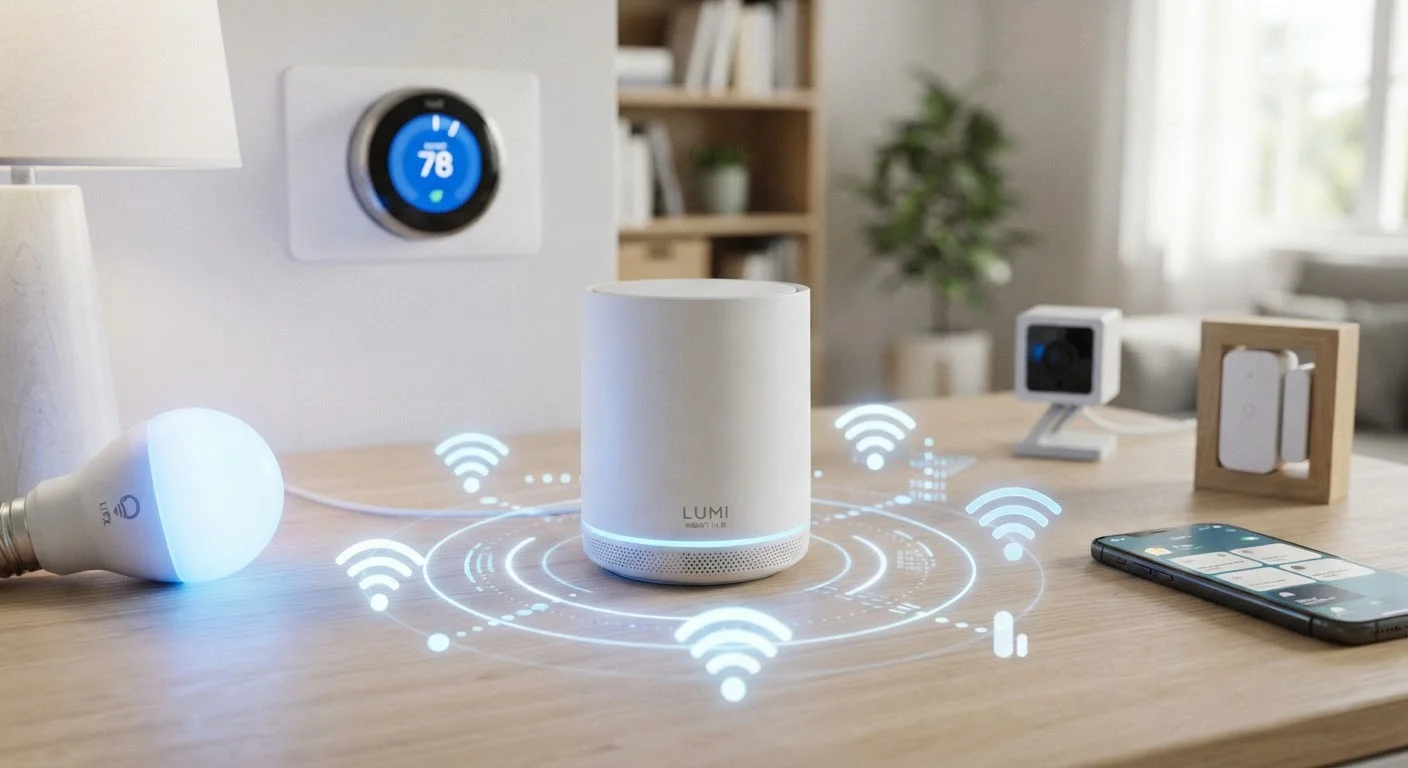
Thread has gained significant momentum through the Matter standard - a cross-industry initiative backed by Apple, Google, Amazon, Samsung, and others - which uses Thread as its preferred protocol for low-power devices. A Thread network requires a border router (a device that bridges Thread to your main network), which is increasingly built into smart speakers and hubs from major platforms. If you're building or expanding a smart home today, Thread-compatible devices offer a degree of future-proofing, though the ecosystem is still maturing. Unfamiliar with terms like border router or Matter? Our connected home glossary explains these concepts in plain language.
Choosing the Right Protocol for Your Setup
The practical decision often comes down to three factors: device type, ecosystem, and scale. For a small apartment with a few smart plugs and a camera or two, Wi-Fi devices are usually the simplest path. For a house with twenty or more connected devices spanning multiple rooms, a mesh protocol like Zigbee, Z-Wave, or Thread reduces router congestion and improves reliability.
Consider what ecosystem or voice assistant you're already invested in - some hubs natively support Zigbee or Z-Wave, while Thread support is increasingly bundled into newer platforms. It's also worth noting that protocols affect security posture: isolated mesh networks can limit certain attack surfaces, while internet-connected Wi-Fi devices require consistent firmware updates. For guidance on keeping any connected device secure, see our article on keeping connected devices secure on your home network. And if you're curious how different rooms call for different device types, our look at how smart home devices are used across the house provides useful real-world context.