Tire Pressure: The Right Number and Where to Find It
Most passenger vehicles operate correctly between 32 and 35 PSI (pounds per square inch), but the exact figure for your car is printed on a sticker inside the driver's door jamb - not on the tire sidewall. The number on the sidewall is the tire's maximum rated pressure, which is different from the recommended inflation level for your vehicle.
Check pressure when tires are cold (driven fewer than one mile), because heat from driving temporarily raises readings by 4-6 PSI and will skew your measurement. If your dashboard lights up with the TPMS symbol, your pressure has likely dropped 25% or more below the recommended level. See our guide to dashboard warning lights for what to do when that symbol appears.
| Recommended Tire Pressure Range | 32-35 PSI (most passenger vehicles) (Check door jamb sticker for your specific vehicle) |
| Legal Minimum Tread Depth (U.S.) | 2/32 of an inch (Federal Motor Vehicle Safety Standards) |
| Practical Replacement Threshold | 4/32 of an inch (Widely recommended by safety organizations) |
| Standard Rotation Interval | Every 5,000-7,500 miles (General industry guidance; check owner's manual) |
| Pressure Drop Per 10°F Temperature Fall | Approximately 1 PSI (Basic gas physics; consistent with industry data) |
| Typical New Tire Tread Depth | 10/32" to 11/32" (Standard for most consumer passenger tires) |
Tire pressure drops roughly 1 PSI for every 10°F drop in ambient temperature, so seasonal checks - especially heading into winter - are worth adding to your routine. Overinflation is just as problematic as underinflation: it reduces the contact patch with the road and accelerates center-tread wear.
Tread Depth: What the Numbers Mean for Safety
New tires typically start at 10/32" to 11/32" of tread depth. U.S. law requires replacement at 2/32", but most safety organizations recommend replacing tires at 4/32" - especially if you drive in rain or snow - because wet-road stopping distances increase significantly below that threshold.
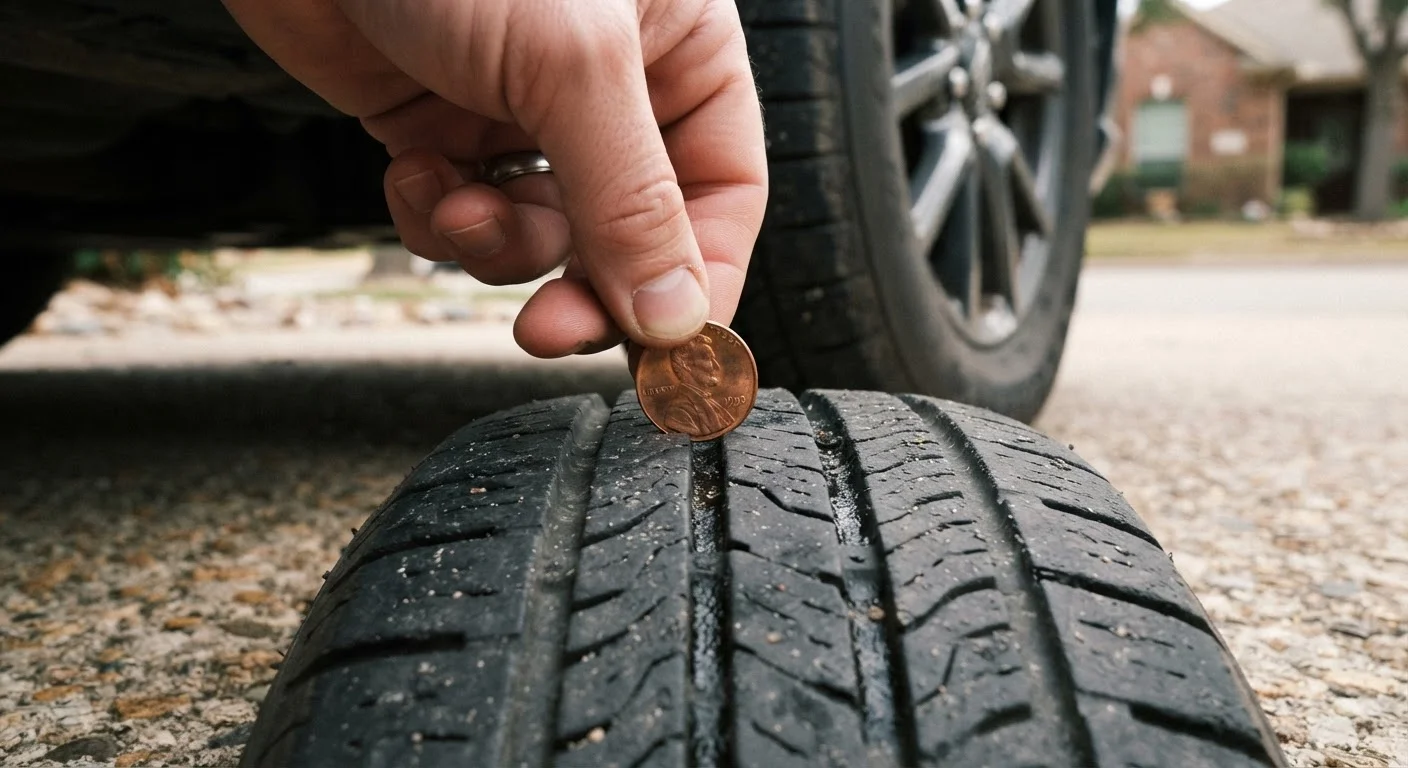
Two common at-home checks: insert a penny into a tread groove with Lincoln's head pointing down. If you can see the top of Lincoln's head, you're at or below 2/32" - replace immediately. Use a quarter instead, and if Washington's head is fully visible, you're at or below 4/32" - start planning for replacement. Our step-by-step tread depth guide walks through both tests in detail.
PSI (Pounds Per Square Inch)
The unit used to measure tire inflation pressure. Your vehicle's recommended PSI is found on the door jamb sticker, not the tire sidewall.
Tread Depth
The measurement from the top of the tread rubber to the bottom of the groove, expressed in 32nds of an inch. It indicates how much grip and water-channeling capability the tire has remaining.
TPMS
Tire Pressure Monitoring System - a federally required sensor system that alerts the driver when one or more tires drops significantly below the recommended inflation level.
Load Index
A numerical code on the tire sidewall that corresponds to the maximum weight each tire can safely carry when properly inflated. Never use a tire with a lower load index than your vehicle requires.
Speed Rating
A letter code on the sidewall indicating the maximum sustained speed the tire is designed to handle safely. Common ratings include S (112 mph), H (130 mph), and V (149 mph).
Aspect Ratio
The two-digit number in a tire size code representing the sidewall height as a percentage of the tire's section width. A lower number means a shorter, stiffer sidewall.
Uneven wear across a tire's surface tells its own story. Edge wear often points to chronic underinflation; center wear suggests overinflation; one-sided wear typically indicates an alignment problem. Address the root cause before installing new tires, or the pattern will repeat.
Rotation Intervals and Patterns
The standard recommendation is to rotate tires every 5,000 to 7,500 miles, or roughly every other oil change. Front tires on front-wheel-drive vehicles wear faster because they handle both steering and power delivery; rotation evens out this wear across all four tires and extends their usable life.
Rotation patterns vary by drivetrain and tire type. The most common patterns are:
- Forward cross - front tires move straight back; rear tires cross to opposite front positions. Used on FWD vehicles.
- Rearward cross - rear tires move straight forward; front tires cross to opposite rear positions. Common on RWD and AWD vehicles.
- X-pattern - all four tires swap diagonally. Used on some FWD vehicles with even wear rates.
Directional tires (those with a one-way tread arrow on the sidewall) can only be rotated front-to-rear on the same side of the vehicle. Staggered fitments - where rear tires are wider than fronts - typically cannot be rotated at all without dismounting and remounting the rubber.
For broader context on how rotation fits into your overall service plan, see your car's maintenance schedule explained.
Decoding the Sidewall Numbers
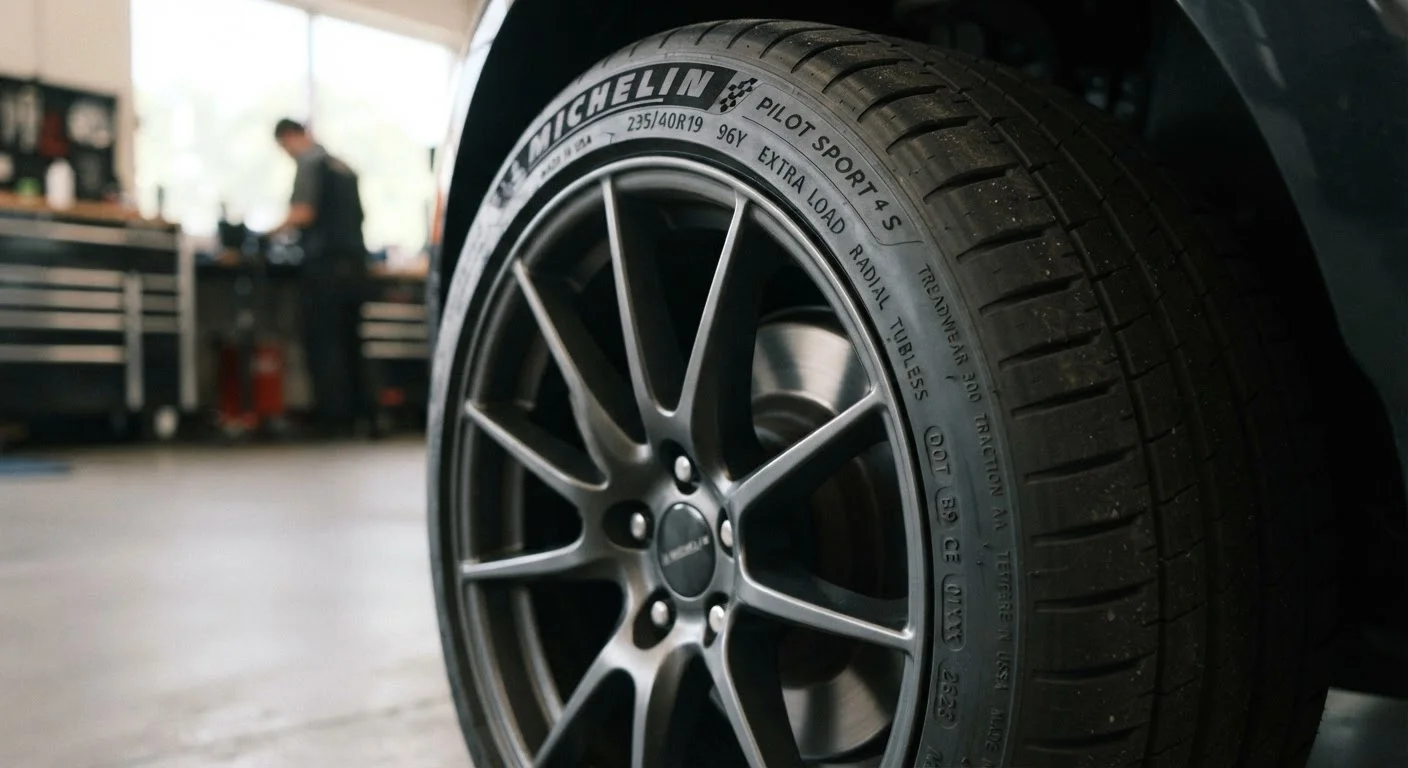
A tire marked P215/65R17 98H breaks down as follows:
| Code | Meaning |
|---|---|
| P | Passenger vehicle (LT = light truck) |
| 215 | Section width in millimeters |
| 65 | Aspect ratio - sidewall height as a percentage of width |
| R | Radial construction |
| 17 | Wheel diameter in inches |
| 98 | Load index (the weight each tire can safely support) |
| H | Speed rating (H = up to 130 mph sustained) |
Never install a tire with a lower load index or speed rating than the vehicle manufacturer specifies. Going wider or changing aspect ratios from the OEM spec can affect speedometer accuracy, clearance, and handling - consult a qualified tire professional before deviating from the door-jamb placard size.
Mixing Tire Types Is Risky
Installing tires of different constructions (e.g., radial and non-radial) or significantly different tread patterns on the same axle can create unpredictable handling, especially during emergency maneuvers. Always replace in axle pairs at minimum, and ideally all four at once when tread depths across tires diverge significantly. If you're unsure, a qualified tire technician can assess what your specific vehicle needs.