What a Gigabyte Actually Means for Your Daily Use
A gigabyte (GB) is a unit of digital data - roughly 1,000 megabytes (MB). On a mobile plan, it represents how much information your phone can send and receive before the carrier applies any speed restrictions. But the number on your plan's label rarely tells you how far that data actually stretches in practice.
Here's a rough sense of scale: checking email and social media for an hour uses well under 100 MB. Streaming music consumes about 40-150 MB per hour depending on quality. Standard-definition video streaming can use around 1 GB per hour, while HD video can push 3 GB or more. A single software update on your phone can consume several gigabytes at once.
Most consumers significantly underestimate video's data appetite. If you stream an hour of HD video daily, you could easily use 90+ GB in a month - far beyond what many mid-tier plans offer at full speed. Tracking your usage in your phone's settings for a month before choosing a plan gives you a reliable baseline.
~1 GB
Data used per hour of SD video streaming
General industry estimates suggest standard-definition streaming consumes roughly 1 GB per hour; HD can use 3 GB or more.
20-100 GB
Typical deprioritization threshold on unlimited plans
Carrier network management disclosures show deprioritization thresholds on unlimited plans commonly range from 20 GB to 100 GB depending on plan tier.
128 Kbps-1 Mbps
Common throttled speed after high-speed data is used
After exceeding a plan's high-speed allotment, carriers typically reduce speeds to a range that supports basic messaging but not HD streaming.
For a broader look at how data terms apply beyond mobile service, the home internet jargon guide covers similar concepts in a fixed broadband context.
Throttling: What Happens When You Hit Your Limit
Throttling refers to a carrier deliberately reducing your data speeds after you've consumed a certain amount of high-speed data within a billing cycle. It's a fixed, plan-defined action - it happens regardless of whether the network is busy or quiet at that moment.
A plan might advertise "15 GB of high-speed data," for example. Once you cross that threshold, your speeds may drop to 128 Kbps or 1 Mbps - slow enough to make video streaming impractical but still usable for basic messaging. You're not cut off entirely; you're just moved to a much slower lane for the rest of the month.
This is distinct from the network having a problem. Throttling is a policy choice written into your plan's terms. Understanding where your plan's throttling threshold sits - and comparing it honestly to your typical usage - is one of the most practical steps you can take before signing up. The full breakdown of what goes into a mobile plan can help you read a plan's fine print more critically.
Check Your Usage Before Choosing a Plan
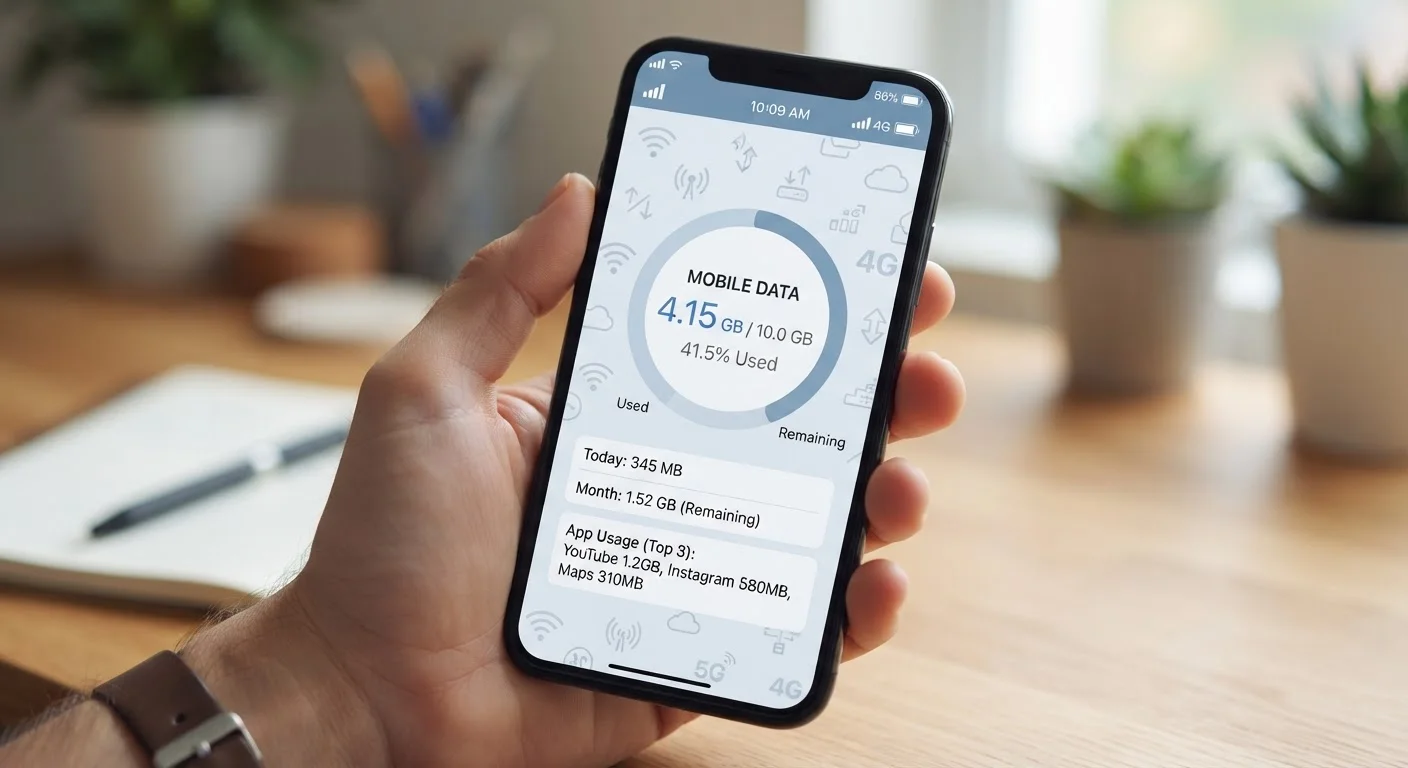
Both Android and iPhone devices include a built-in data usage tracker under network or cellular settings. Review it at the end of your billing cycle each month for two to three months. This gives you a realistic baseline - not a guess - for how much high-speed data you actually need in a plan.
Deprioritization: The "Unlimited" Plan Caveat
Deprioritization is a different mechanism, and it's the one most often buried in the fine print of unlimited plans. Unlike throttling, deprioritization doesn't permanently cap your speed. Instead, when a cell tower is handling heavy traffic and you've exceeded a usage threshold (commonly somewhere between 20 GB and 100 GB, depending on the plan), the carrier may temporarily move your data requests to the back of the queue.
During uncongested periods, you'd never notice deprioritization at all. During peak hours in a dense area - a stadium, a busy downtown corridor, a concert venue - you might experience noticeably slower speeds while customers on higher-priority tiers get through more quickly.
This also affects customers of mobile virtual network operators (MVNOs), who lease tower access from major carriers. MVNO subscribers are typically deprioritized below the host carrier's direct customers, which is one of the practical trade-offs of lower-cost service. Understanding congestion-related slowdowns is also connected to the broader question of why your phone signal drops in specific locations.
Reading "Unlimited" Plans More Carefully
The word "unlimited" on a mobile plan does not mean unrestricted. It almost always means unlimited total data volume - you won't be cut off - but it does not guarantee full speeds throughout the month. Carriers layer throttling thresholds and deprioritization policies within plans marketed as unlimited, and these details are disclosed in the plan's terms rather than the headline advertising.
When comparing unlimited plans, look specifically for the premium data or high-speed data allotment figure - this is the amount of data you get at full, unmanaged speeds before deprioritization or throttling kicks in. Higher-tier plans within the same carrier typically offer a larger premium data allotment and higher network priority.
Separately, consider whether a plan is subject to a hard video-streaming quality cap, which some plans apply independently of your data usage. These caps limit video resolution regardless of available network capacity. The complete guide to mobile phone contracts explains how these terms appear in service agreements and what you're actually committing to. For practical ways to manage usage once you've chosen a plan, see habits that help keep mobile costs under control.