What Sets These Two Standards Apart
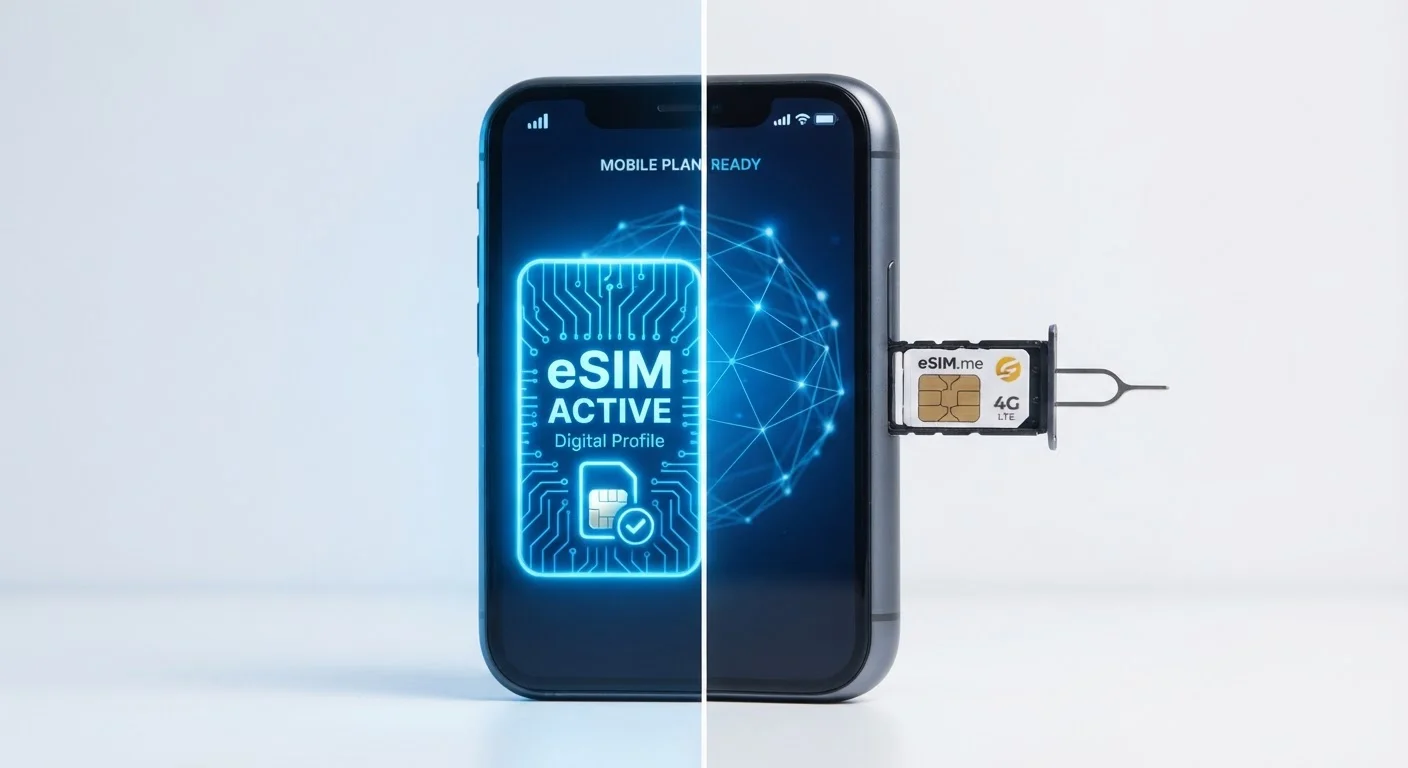
A physical SIM (Subscriber Identity Module) is a small removable card - typically nano-SIM size in modern phones - that stores your carrier credentials and authenticates your device on a network. You insert it into a tray, and the phone reads it each time it connects.
An eSIM (embedded SIM) performs the same authentication function, but the chip is soldered directly into the device at the factory. Instead of swapping cards, you activate a carrier profile by scanning a QR code, using a carrier app, or going through a menu in your phone's settings. The profile is downloaded and stored on the chip electronically.
Both standards ultimately do the same job - proving to a network that you're an authorized subscriber - but they differ significantly in how you interact with them day to day.
| Criterion | eSIM | Physical SIM |
|---|---|---|
| Form factor | Embedded chip, no physical card | Removable nano-SIM card |
| Activation method | QR code, app, or settings menu | Insert card into device tray |
| Carrier switching speed | Minutes, done remotely | Requires new physical card |
| Multiple profiles | Yes, several stored simultaneously | Limited to physical slots (usually 1-2) |
| Device compatibility | Newer flagships; not all budget phones | Nearly all mobile devices |
| International usability | Growing, but varies by country | Widely accepted globally |
| Moving SIM to another phone | Requires carrier re-provisioning | Physical swap in seconds |
| Water/dust resistance impact | Helps - no tray opening needed | Tray can compromise sealing |
Setup, Activation, and Switching Carriers
Setting up a physical SIM is hardware-dependent: you need the card in hand, a compatible tray, and occasionally a SIM ejector tool. If you're switching carriers, you request a new SIM (by mail or in-store), swap it out, and you're live. The process is tactile and universally understood, which is why it remains the default in many parts of the world.
eSIM activation is handled entirely through software. Most major U.S. carriers support eSIM provisioning, meaning you can go from purchasing a plan to being connected in a matter of minutes - entirely remotely. This is particularly useful when setting up a new phone out of the box or when adding a secondary line for travel or work.
Where eSIM can create friction is in carrier transfers. Moving an eSIM profile between devices isn't as simple as physically moving a card; it typically requires the carrier to re-provision the profile on the new device. If you regularly buy and sell phones or share a single line across multiple handsets, a physical SIM offers more straightforward portability. For a broader look at what phone ownership flexibility really means, see our article on the real trade-offs of buying an unlocked phone.
~50%
U.S. smartphones shipped with eSIM support
Industry analysts estimated that roughly half of all smartphones shipped in the U.S. in recent years included eSIM capability, a share that has grown steadily as flagship models standardize the technology.
200+
Countries with at least some eSIM carrier support
According to GSMA data, eSIM support has expanded to over 200 countries, though the depth of carrier adoption varies considerably by region.
2 mins
Typical eSIM activation time on major U.S. carriers
Most major U.S. carriers report that QR-code-based eSIM activation for a new line or device transfer typically completes in under two minutes under normal network conditions.
Compatibility, Coverage, and Practical Limitations
Physical SIM cards have near-universal compatibility. Any GSM or CDMA device with a SIM tray will accept the appropriate card size, and virtually every carrier worldwide issues them. For consumers in rural areas, developing markets, or regions where eSIM infrastructure is still maturing, physical SIM remains the only practical option.
eSIM support, while growing rapidly, is still uneven. As of recent years, most flagship Android and Apple devices support eSIM, and some newer models - including certain iPhone models sold in the U.S. - have removed the physical SIM tray entirely, making eSIM mandatory. However, budget smartphones, older handsets, and many connected devices such as basic wearables may only support physical SIMs.
eSIM's multi-profile capability is one of its most practical advantages: a single device can store several carrier profiles simultaneously and switch between them in settings. This is useful for maintaining a domestic plan and a travel plan on the same phone without carrying two devices. For tips on connected devices that use these standards differently, explore the connected devices hub.
eSIM-Only Devices: What to Know Before You Buy
Some newer smartphones sold in the United States ship without a physical SIM tray, relying entirely on eSIM. Before purchasing one of these devices, confirm that your carrier supports eSIM provisioning and that you have reliable internet access to complete activation. If you travel to regions with limited eSIM infrastructure, you may have fewer local carrier options than you would with a physical SIM slot.