
How Each Technology Actually Works
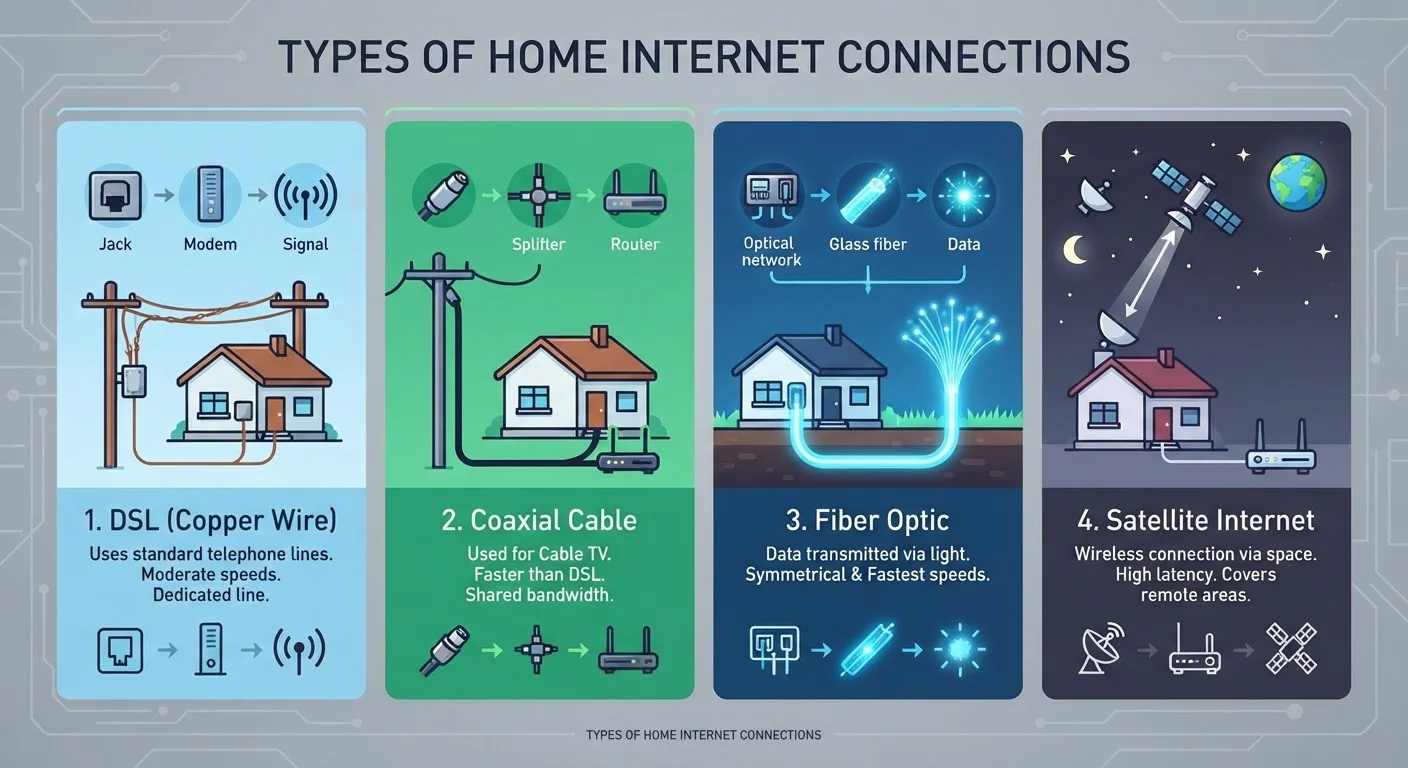
Fixed wireless internet and satellite internet both solve the same core problem - delivering broadband to homes that cable and fiber infrastructure doesn't reach - but they do it in fundamentally different ways.
Fixed wireless transmits internet signals via radio waves between a ground-based tower operated by a local or regional internet service provider and a small receiver antenna mounted on your home. Because both endpoints are on or near the ground, the signal travels a relatively short distance - usually a few miles - at low altitude. This keeps latency low and data transfer efficient. However, it typically requires a clear line of sight between your home and the tower, meaning hills, dense tree cover, or buildings can block the signal.
Satellite internet routes your connection through orbiting satellites. Traditional systems used geostationary satellites (GEO) parked roughly 22,000 miles above the equator, which introduced significant signal delay. Newer low Earth orbit (LEO) satellite constellations operate at altitudes of 300 to 1,200 miles, dramatically reducing that round-trip time. For a broader overview of how satellite internet fits within the spectrum of home broadband technologies, see our guide to internet types.
| Criterion | Fixed Wireless | Satellite Internet |
|---|---|---|
| Typical Latency | 10-50 ms | 20-60 ms (LEO); 500-800 ms (GEO) |
| Download Speeds | 25-100 Mbps (varies by provider) | 25-150 Mbps (LEO); 12-25 Mbps (GEO) |
| Coverage Area | Depends on tower proximity | Near-global (especially LEO) |
| Line of Sight Required | Yes - to ground tower | Yes - clear view of sky |
| Weather Sensitivity | Moderate (wind, dense foliage) | Moderate to high (rain fade) |
| Typical Data Caps | Varies; some unlimited plans | Often present; varies by plan |
| Equipment Required | Directional antenna on home | Satellite dish on home |
Speed, Latency, and Real-World Performance
On paper, both technologies can advertise download speeds capable of supporting streaming and general browsing. In practice, the differences emerge in latency - the time it takes data to make a round trip between your device and a server.
Fixed wireless typically delivers latency between 10 and 50 milliseconds, which is comparable to DSL or cable. This range is acceptable for video conferencing, cloud-based work tools, and casual online gaming. Satellite internet using geostationary satellites carries latency of 500 to 800 ms, which creates noticeable delays in these same applications. LEO satellite systems have brought that figure closer to 20-60 ms under good conditions, though it can rise under network congestion or adverse weather.
Download speeds vary considerably by provider and location. Fixed wireless users in well-served areas may see 25-100 Mbps, while some LEO satellite plans advertise median speeds in a similar range. Upload speeds on both technologies tend to lag behind downloads, which matters for remote workers regularly sharing large files or participating in video calls. Before committing to either service, it's worth assessing your household's actual bandwidth requirements - our article on what internet speed you actually need provides a practical framework.
21 million
Americans lacking reliable broadband access
The FCC's Broadband Data Collection maps show tens of millions of U.S. locations without access to 25/3 Mbps service, concentrated in rural areas.
~35 ms
Median latency for LEO satellite (reported)
Independent speed-test aggregators have reported median round-trip latency for leading LEO satellite services in the 30-50 ms range under typical conditions.
25 Mbps / 3 Mbps
FCC minimum broadband definition
The FCC defines broadband as at least 25 Mbps download and 3 Mbps upload, though the agency has proposed raising this benchmark significantly.
Availability, Installation, and Coverage Gaps
Coverage is where the two technologies diverge most sharply. Fixed wireless availability is inherently local - a provider must have built tower infrastructure within range of your home, and your property must have a workable line of sight to that tower. Rural terrain with rolling hills, forests, or narrow valleys can eliminate fixed wireless as a viable option even when a tower exists nearby.
Satellite internet's coverage footprint is far broader. LEO constellations, in particular, are designed to cover most of the globe, including areas where no other broadband infrastructure is economically viable. Installation for both services involves professional or self-installation of external hardware: a small dish for satellite, a directional antenna for fixed wireless. Setup requirements and the impact of your home's placement on signal quality are covered in our home Wi-Fi setup guide.
Check Availability Before Assuming Either Option Works
Fixed wireless availability is not uniform across rural America - a provider serving one county may not operate in the next. Before making any decisions, use the FCC's Broadband Map or contact local ISPs directly to confirm what services reach your specific address. Satellite internet has broader coverage but may still have waitlists or geographic exclusions depending on the provider and constellation capacity in your region.
Weather Sensitivity and Reliability
Neither fixed wireless nor satellite internet is immune to weather-related disruption, but the nature of that vulnerability differs. Satellite signals - particularly from GEO systems - are susceptible to a phenomenon called rain fade, where heavy precipitation absorbs or scatters the signal traveling through the atmosphere. LEO systems are somewhat less affected because their signals travel a shorter path through the atmosphere, but heavy rain or snow can still degrade performance temporarily.
Fixed wireless is generally more resilient to rain fade because the signal path is shorter and lower. However, it can be affected by extreme wind if the receiving antenna is displaced, or by dense foliage during summer months obstructing a borderline line-of-sight path. Reliability over time also depends on the provider's network maintenance and capacity management - a local fixed wireless ISP serving a small rural customer base may have different reliability characteristics than a large national satellite operator.
For a deeper look at what satellite internet's limitations mean in day-to-day use, our companion article on satellite internet trade-offs provides a balanced assessment.