
Why Satellite Internet Exists - and Who It's Really For
Tens of millions of Americans live in areas where cable, fiber, and even DSL lines simply don't reach. Building ground-based broadband infrastructure in low-density rural regions is expensive, and many providers have little financial incentive to do it. Satellite internet was designed to solve exactly that problem - delivering a connection from orbit to virtually any location on Earth that has a clear view of the sky.
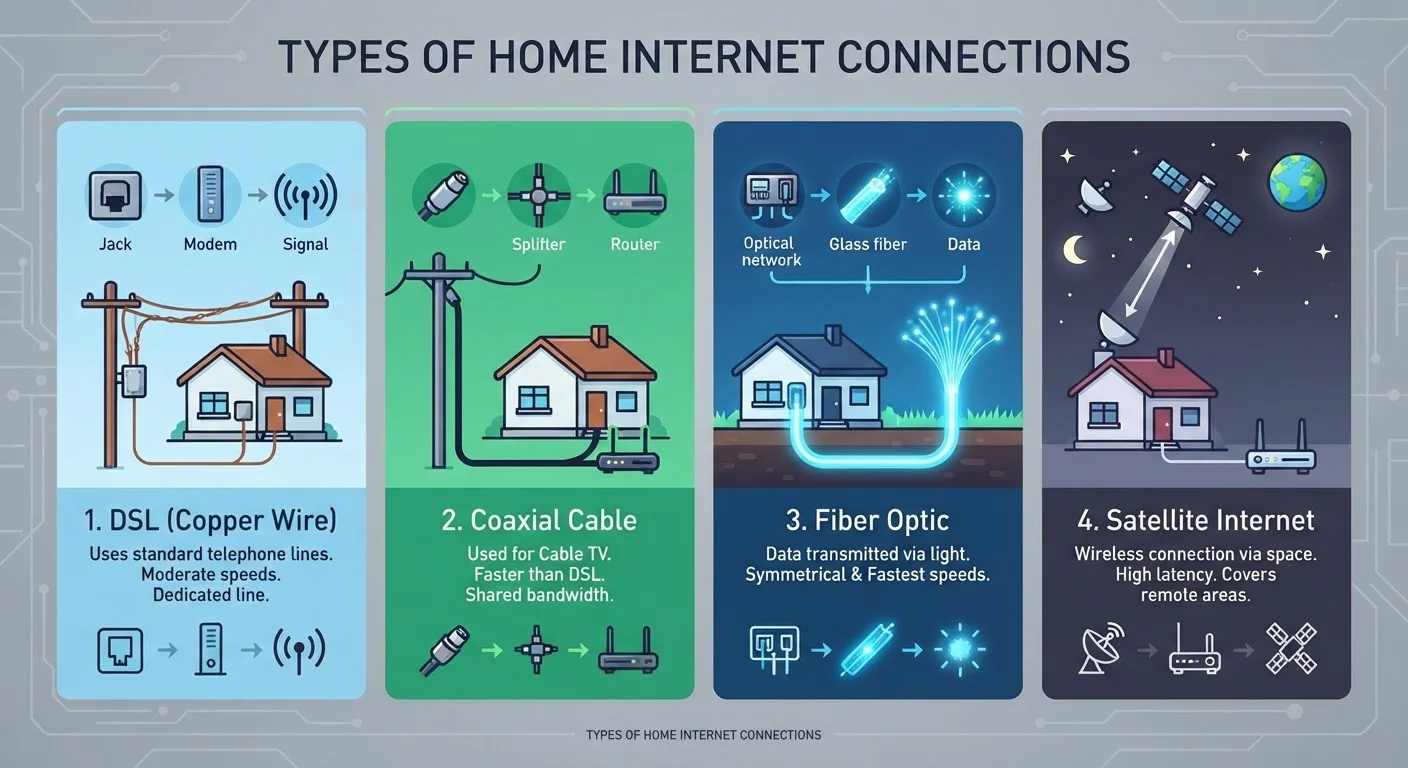
If you're evaluating satellite internet, your starting point matters. For a household with access to cable or fiber, satellite is rarely the rational choice. But for someone on a remote property, a farm, or a mountain community, it may be the only viable broadband option available. Understanding how satellite compares to other connection types is a useful first step before committing to any plan.
Available in remote areas with no wired infrastructure
Satellite internet can serve virtually any location with an unobstructed view of the sky, making it one of the few practical options for rural homes, farms, and off-grid properties.
No dependence on local ground-based network build-out
Because service comes from orbit, subscribers aren't waiting on a provider to run cable or fiber down their road - coverage is determined by satellite footprint, not local investment decisions.
LEO systems offer meaningful speed improvements over older satellites
Low-Earth orbit satellite constellations have brought download speeds into the range of 50-250 Mbps for many users, a substantial improvement over older geostationary systems that often struggled to exceed 25 Mbps.
Provides a backup connectivity option during ground outages
Because satellite infrastructure is independent of terrestrial networks, it can continue functioning during local cable cuts or ground-level outages, offering a degree of resilience for critical connectivity needs.
The Real Limitations You Should Know Before Signing Up
Satellite internet's core challenge is physics. Traditional geostationary satellites orbit roughly 22,000 miles above Earth - a distance that creates a measurable round-trip signal delay, known as latency, typically between 500 and 700 milliseconds. Even newer low-Earth orbit (LEO) systems, which orbit at altitudes between 200 and 1,200 miles, still carry higher latency than most wired connections, generally in the 25-60 ms range.
That latency gap matters in practical terms. Video conferencing, online gaming, and real-time applications are all sensitive to delay. Buffered streaming is usually manageable, but live interactions can feel noticeably sluggish compared to a cable or fiber connection.
Weather is another variable. Heavy rain, snow, and dense cloud cover can degrade or temporarily interrupt a satellite signal - a phenomenon sometimes called rain fade. Dish placement matters too: obstructions like trees, buildings, or hillsides can block the line of sight required for a reliable connection.
Higher latency than wired broadband alternatives
Even LEO satellite systems carry more latency than cable or fiber, making real-time applications like competitive gaming or video conferencing less smooth than users of wired connections typically experience.
Signal quality vulnerable to adverse weather
Heavy rain, snow, and dense cloud cover can attenuate or interrupt the satellite signal, a limitation that is particularly relevant in regions with frequent severe weather.
Higher cost per megabit compared to wired options
Monthly plan prices and equipment costs for satellite internet are generally higher than equivalent-speed cable or fiber plans, which can be a significant factor for cost-sensitive households.
Data caps and speed throttling are common
Many satellite plans impose monthly data thresholds, after which speeds are reduced - sometimes dramatically - until the billing cycle resets, limiting heavy streaming or remote-work use.
Requires clear sky view and precise dish installation
Trees, chimneys, hillsides, and other obstructions can block the signal, and proper dish alignment is essential; renters or those on heavily wooded lots may face installation challenges.
~600ms
Typical latency for geostationary satellite
Geostationary satellites orbit at roughly 22,000 miles altitude, producing round-trip signal delays that make real-time applications noticeably sluggish compared to wired broadband.
25-60ms
Latency range for LEO satellite systems
Low-Earth orbit constellations orbit much closer to Earth, reducing latency to ranges that, while still above fiber, are far more manageable for everyday use including video calls.
21M+
Rural Americans lacking access to wired broadband
According to the FCC's broadband reporting data, millions of rural Americans have limited or no access to fixed wired broadband, making satellite one of few viable options.
Cost, Data Caps, and Contract Considerations
Satellite internet plans tend to carry a higher monthly cost per megabit of speed compared to wired alternatives. Equipment costs - including the dish and router - can add a significant upfront expense, sometimes several hundred dollars, depending on the provider and plan structure. Some providers offer to roll equipment costs into a monthly fee, which can spread the outlay but increases the total cost over time.
Data caps remain common in satellite plans. Once a monthly threshold is reached, speeds are often throttled rather than cut off entirely, but the slowdown can be significant enough to affect everyday use. If your household streams video heavily or works from home using large file transfers, it's worth calculating your typical monthly data consumption before selecting a tier.
Early termination fees are another point to verify. Some satellite contracts lock subscribers in for one to two years with meaningful penalties for cancelling early. See what to check before signing any internet contract to avoid surprises after installation.
How Satellite Stacks Up Against Fixed Wireless
For rural users who have any ground-based alternative, fixed wireless internet is often worth considering alongside satellite. Fixed wireless uses radio signals transmitted from a nearby tower to a receiver mounted on your home. It typically offers lower latency than satellite and competitive speeds, though it requires line of sight to a tower and is limited by tower coverage geography.
Neither option is universally superior - the right fit depends on your location, the coverage available, and how you use the internet. A detailed side-by-side look at fixed wireless versus satellite internet can help clarify which makes more sense for your specific situation.
LEO vs. Geostationary: A Key Distinction
Not all satellite internet services are the same. Traditional geostationary (GEO) satellites sit in a fixed position 22,000 miles up and serve large coverage areas with higher latency. Newer low-Earth orbit (LEO) constellations use many smaller satellites in lower orbits, resulting in reduced latency and higher speeds. When comparing plans, confirming which type of satellite network a provider uses will significantly affect what experience you should expect.