
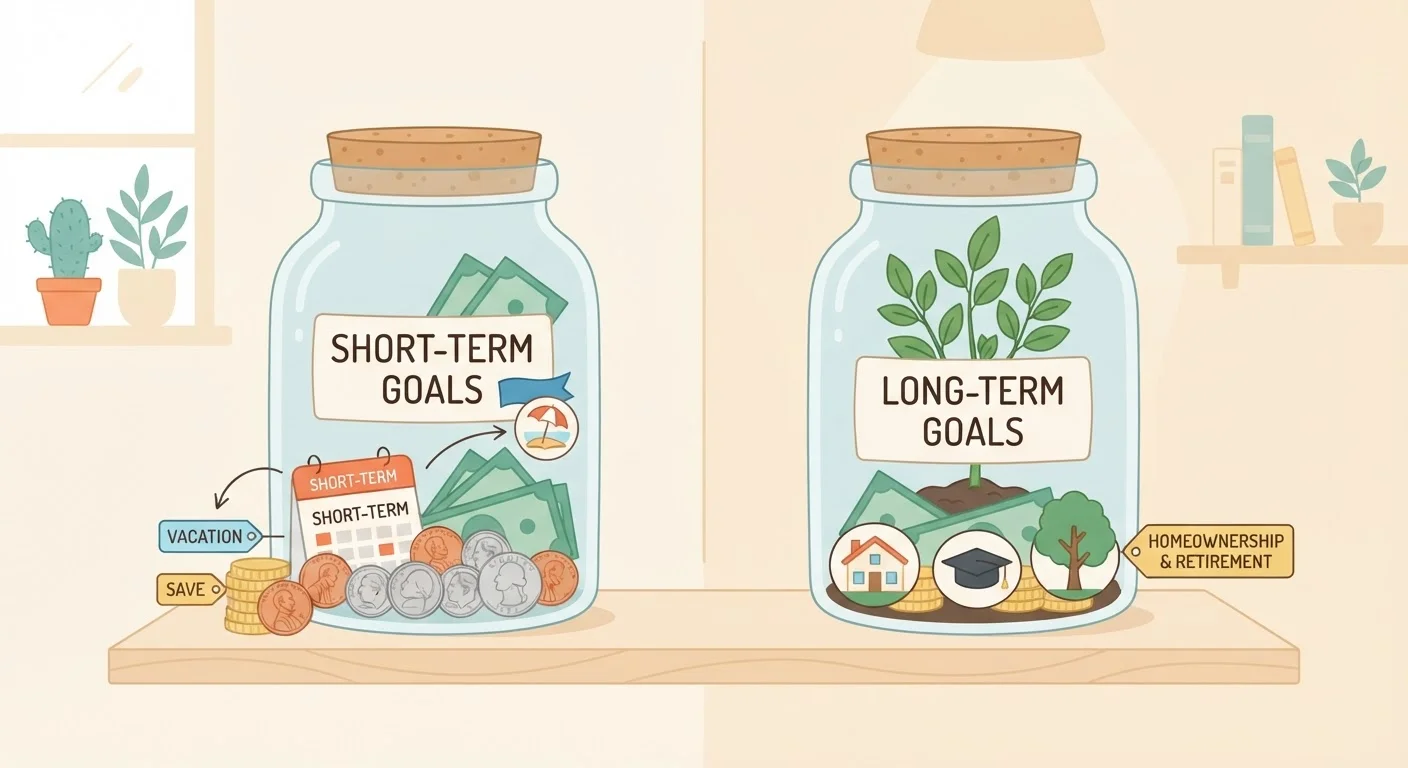
What Makes a Goal Short-Term or Long-Term?
The defining factor is your time horizon - how long you have before you need to use the money. Short-term goals are generally those you plan to fund within one to three years. Long-term goals sit five or more years out, with many stretching across decades.
Examples help make this concrete. A short-term goal might be building a three-month emergency fund, saving for a holiday trip, replacing a worn-out car, or covering an upcoming home repair. A long-term goal could be a down payment on a house (if you are early in the saving process), paying for a child's college education, or - the most common long-term goal of all - retirement.
The distinction matters because the strategy that serves one type of goal can actively work against the other. Short-term money needs to be safe and accessible. Long-term money benefits from growth potential, which usually means accepting more short-term fluctuation. Mixing these up - say, investing your emergency fund in a volatile asset or leaving your retirement savings in a basic checking account - leaves you exposed on both ends.
Understanding where each goal falls also helps you frame savings targets in realistic, motivating ways rather than treating every goal as identical.
How Accounts and Vehicles Differ by Timeline
For short-term goals, the priorities are liquidity (you can access funds quickly without penalty) and capital preservation (the balance does not drop unexpectedly). Common home bases for short-term savings include high-yield savings accounts, money market accounts, and certificates of deposit with short maturities. These options keep pace with or slightly ahead of inflation while protecting the principal.
High-yield savings accounts vs. traditional savings accounts is a comparison worth understanding here - the difference in annual percentage yield can meaningfully affect how quickly a short-term goal funds itself.
For long-term goals, the calculus shifts. Because you have years or decades before the money is needed, your savings can ride out market cycles. This opens the door to tax-advantaged accounts - like a 401(k) or IRA for retirement - where investment growth can compound over time. The tradeoff is reduced liquidity: withdrawing early from many long-term vehicles carries tax consequences or penalties.
| Criterion | Short-Term Goals | Long-Term Goals |
|---|---|---|
| Typical timeline | Under 3 years | 5+ years (often decades) |
| Primary priority | Liquidity and stability | Growth and compounding |
| Suitable accounts | High-yield savings, money market, short CDs | 401(k), IRA, brokerage accounts |
| Risk tolerance needed | Low - protect the principal | Moderate to higher - ride out cycles |
| Access to funds | Readily accessible | Often restricted or penalized early |
| Examples | Emergency fund, vacation, appliance | Retirement, college fund, home purchase |
Keeping too much cash in liquid accounts for too long carries its own risk, as holding excess cash in savings has real tradeoffs worth understanding - including the drag of inflation eroding purchasing power over time.
Running Both Goals at Once
Most people need to pursue short-term and long-term goals simultaneously, and that is both normal and manageable. The key is to treat them as separate buckets, not competing priorities draining one pool of money.
A practical approach: automate a fixed contribution to each goal every pay period. Even modest amounts add up. Automating removes the willpower requirement and makes consistent saving the default behavior. If your budget feels too tight for both, start small - any amount directed toward a goal builds the habit and grows over time.
Starting Small Is Still Starting
You do not need to save large sums from day one to make progress. Consistent small contributions build momentum and establish saving as a default behavior rather than a special effort. Concerns like 'I don't earn enough yet' are among the common savings myths that keep people from getting started - the habit matters more than the size of the initial contribution.
Labeling separate accounts for distinct goals - rather than letting everything pool together - is a strategy many savers find keeps them on track. Our overview of how people mentally frame savings goals covers why this works and what options exist.
As your income and life circumstances change, your goal mix will shift too. A guide to saving across life stages can help you anticipate how priorities evolve from early adulthood into retirement - and plan your contributions accordingly.
This article is for general informational and educational purposes only and does not constitute personalized financial, investment, tax, or legal advice. Consult a qualified financial professional before making decisions specific to your situation.