
Why Framing Your Goal Matters More Than You Might Think
Most people know they should save more. The harder question is why saving feels easy some months and nearly impossible others - even when income stays the same. Behavioral research consistently points to one underappreciated variable: how the goal is mentally framed in the first place.
Framing isn't a trick or a shortcut. It's the structure you build around a savings target that helps your brain treat it as meaningful rather than abstract. A goal labeled "$5,000" sitting in a generic savings account competes with every other spending impulse on equal footing. The same money labeled "Kayla's Emergency Fund - Do Not Touch" carries an entirely different psychological weight.
This article walks through the most common ways people frame savings goals, what each approach looks like in practice, and which tend to produce consistent follow-through. If you're still working on building the savings habit from scratch, the beginner's guide to building a savings habit is a useful companion read.
Try One New Framing Approach at a Time
It's tempting to overhaul your entire savings system at once, but layering too many changes simultaneously makes it hard to know what's actually working. Pick one framing strategy - a named sub-account, a visual tracker, or a deadline - and run with it for 60 to 90 days before evaluating. Small, deliberate experiments tend to produce more durable habits than wholesale makeovers.
Seven Ways People Frame Savings Goals - and What Makes Each Work
Naming Goals After Their Purpose, Not Their Dollar Amount
Calling a savings bucket "New Car Fund" or "Home Down Payment" instead of "$15,000 Goal" anchors the money to a concrete outcome. The label acts as a mental cue every time you log in or check your balance. Research in behavioral economics suggests that people are more reluctant to dip into a named fund for unrelated purchases - the purpose creates a soft psychological barrier that a plain balance figure doesn't.
This approach pairs naturally with dedicated sub-accounts, which many banks and credit unions allow you to create and label individually at no extra cost.
A named goal feels harder to abandon than an anonymous dollar figure sitting in a generic account.
Breaking One Large Goal into Visible Milestones
A $10,000 emergency fund feels overwhelming when you're starting from zero. Dividing it into five $2,000 milestones - each treated as its own mini-finish-line - gives your brain more frequent signals of achievement. That dopamine feedback loop isn't trivial: it's one reason milestone-based goal structures tend to outperform "save until you hit the number" approaches in sustained follow-through.
Practically, this can be as simple as marking milestones on a spreadsheet or a notes app. The key is celebrating each stage as a real win, not just a waypoint. For more on structuring different types of goals, see how short-term and long-term goals call for different strategies.
Smaller milestones give your brain more frequent wins, making it easier to stay motivated over months.
Using Visual Progress Trackers
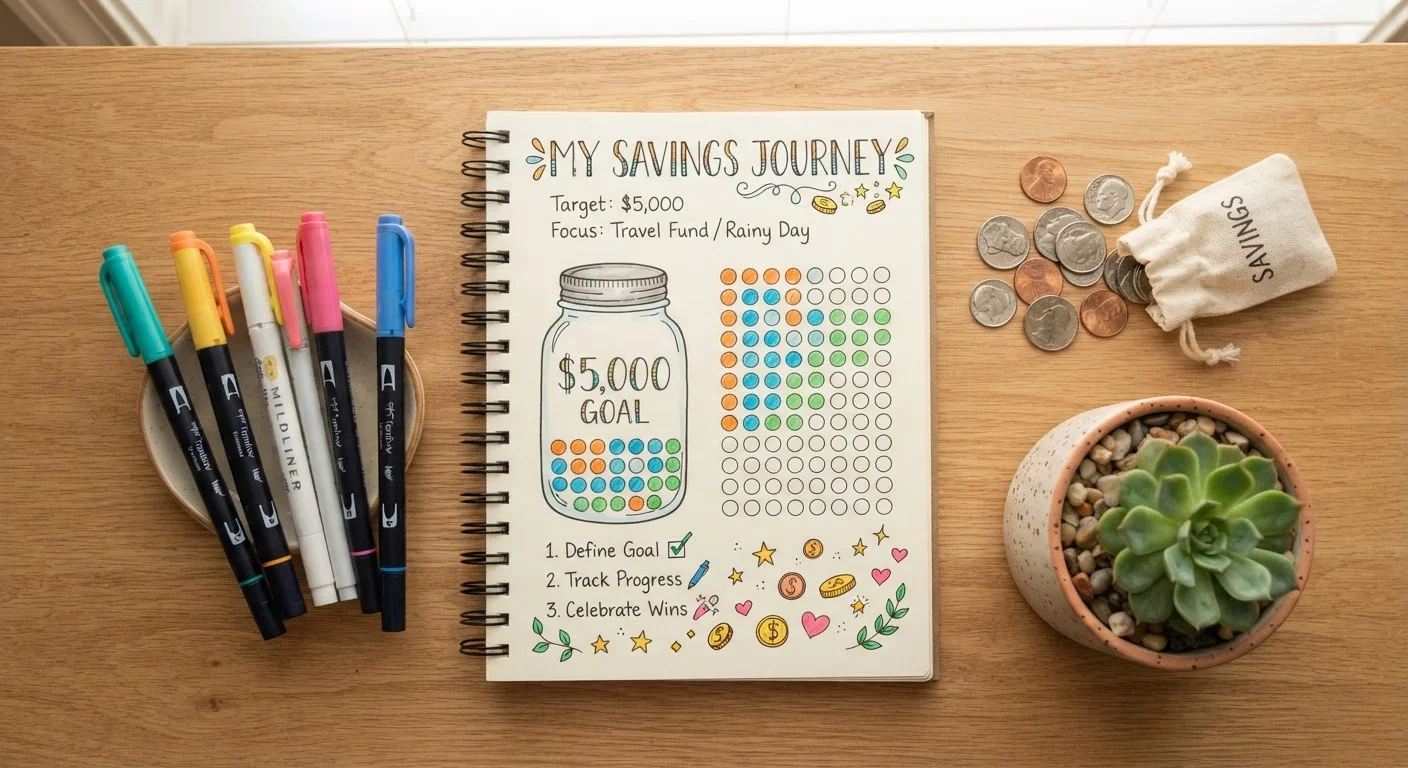
Some people find that seeing progress drawn out - a savings thermometer on the fridge, a coloring chart, a simple bar graph - keeps the goal from drifting out of mind. Visual trackers create a physical reminder that exists outside your banking app, which means the goal stays present in your daily environment rather than hidden behind a login screen.
Hand-drawn trackers work just as well as printed templates. The act of filling in a box or shading a section yourself may actually strengthen the sense of ownership over the progress.
When a savings goal lives somewhere you can see it daily, it competes more fairly with daily spending temptations.
Framing the Goal Around a Deadline, Not Just a Target
"Save $3,000" is open-ended. "Save $3,000 by next June for a family trip" introduces urgency and reverse-engineering potential: you can divide the total by the number of months remaining to find an exact monthly contribution. Deadline-anchored goals convert abstract ambitions into arithmetic - and arithmetic is much easier to act on.
The framework for setting savings goals you'll actually reach explores how specificity and realism work together to raise completion rates.
Pairing a savings target with a firm deadline transforms it from a wish into a workable monthly number.
Treating Savings as a Fixed Expense, Not Leftover Money
One of the most durable mental reframes is moving savings from the end of the budgeting process to the beginning. Instead of "save whatever's left over," the mindset becomes "pay myself first, then manage what remains." Automating a fixed transfer on payday locks this frame in mechanically - it removes the decision from the equation entirely, which dramatically reduces the drag of daily willpower.
This concept connects directly to core budgeting strategies that prioritize fixed allocations before discretionary spending.
Automating savings before discretionary spending removes the daily decision - and the daily temptation.
Anchoring the Goal to Identity, Not Just Outcome
"I want $1,000 in my emergency fund" describes a desired outcome. "I'm the kind of person who keeps an emergency fund" describes an identity - and identity-based framing tends to be stickier. When saving becomes part of how you think about yourself rather than a task on a to-do list, skipping a contribution starts to feel inconsistent with who you are, not just inconvenient.
This isn't about self-deception. It's about building a consistent internal narrative that supports the behavior you're trying to sustain. It works best when combined with even small, consistent actions that reinforce the narrative over time.
Framing saving as part of your identity makes skipping a contribution feel like a contradiction, not just an inconvenience.
Connecting the Goal Explicitly to a Life Stage or Life Event
Savings goals tied to a meaningful life moment - a child starting school, a planned career change, a milestone birthday - carry emotional weight that purely financial goals often lack. That emotional connection raises the perceived cost of abandoning the goal and can sustain motivation through the inevitable stretches when progress feels slow.
Life-stage framing is particularly useful when priorities are shifting. The guide to saving across life stages covers how goal structures reasonably evolve from early adulthood through retirement.
A goal tied to a meaningful life moment carries emotional stakes that make it significantly harder to quietly abandon.
Common Savings Myths Can Get in the Way
Sometimes the obstacle to saving isn't method - it's a belief that saving isn't yet possible. If thoughts like "I don't earn enough to save" are holding you back, it may be worth revisiting those assumptions. The article on savings myths that keep people from getting started examines several widely held beliefs that tend to fall apart under scrutiny.
This article is for general informational and educational purposes only. It is not personalized financial advice. For guidance specific to your situation, consider consulting a qualified financial professional.