
How Each Account Type Works
Both high-yield savings accounts and traditional savings accounts are deposit accounts designed to hold money you're not spending right away. Your deposits are protected by FDIC insurance (or NCUA insurance at credit unions) up to applicable federal limits, so neither option puts your principal at risk in the way that investing does.
The core structural difference is the annual percentage yield (APY) - the rate at which your balance earns interest over a year, accounting for compounding. Traditional savings accounts at large national banks have historically offered very low APYs, sometimes a fraction of a percent. High-yield savings accounts, frequently offered by online banks or online divisions of larger institutions, routinely offer APYs several times higher than the national average.
Both account types allow deposits and withdrawals, though some institutions limit certain types of outgoing transfers per month. Neither account is designed for frequent transaction use the way a checking account is.
| Criterion | High-Yield Savings Account | Traditional Savings Account |
|---|---|---|
| Typical APY | Significantly above national average | Often near or below national average |
| FDIC/NCUA Insured | Yes (up to federal limits) | Yes (up to federal limits) |
| Where offered | Primarily online banks | Brick-and-mortar and online banks |
| Branch access | Rarely available | Usually available |
| Transfer speed to checking | 1-3 business days (external) | Often instant (same institution) |
| Rate variability | Variable, tracks market rates | Variable, often slow to rise |
| Minimum balance requirements | Varies by institution | Varies by institution |
Interest Rates: Where the Real Difference Lives
The gap in interest rates between these two account types is the reason this comparison matters for everyday savers. When interest rates are elevated broadly, HYSAs tend to pass those gains along more quickly than traditional bank savings accounts do. When rates fall, HYSA rates typically adjust downward too - rates on both account types are variable, not locked in.
~0.46%
National average savings account APY
According to the FDIC, the national average savings account interest rate has historically hovered well below 1%, even during periods of higher market rates.
4-5x
Typical HYSA APY advantage over national average
During periods of elevated benchmark rates, many high-yield savings accounts have offered APYs several times higher than the national average for traditional savings accounts.
$400+
Potential extra annual interest on $10,000
A rough illustration: a 4-percentage-point APY gap on a $10,000 balance can result in roughly $400 more in interest earned per year in the higher-rate account.
Even modest differences in APY compound meaningfully over time. On a $10,000 balance, the difference between a 0.5% APY and a 4.5% APY is roughly $400 in additional interest earned over a single year. That gap widens as balances grow and time passes. Understanding this is part of building a stronger savings mindset - for more on how consistent small steps build financial momentum, see what your savings rate really means.
Access, Convenience, and Account Features
Traditional savings accounts at brick-and-mortar banks offer branch access, in-person customer service, and tight integration with checking accounts at the same institution. For many people, that seamlessness is valuable - instant transfers between linked accounts and easy cash deposits are genuine advantages.
High-yield savings accounts are most commonly held at online-only banks. This means no physical branch to visit if something goes wrong, though most reputable online banks offer robust customer support by phone or chat. Transfers between a HYSA and your external checking account generally settle in one to three business days, which is worth factoring in if you need to access funds quickly.
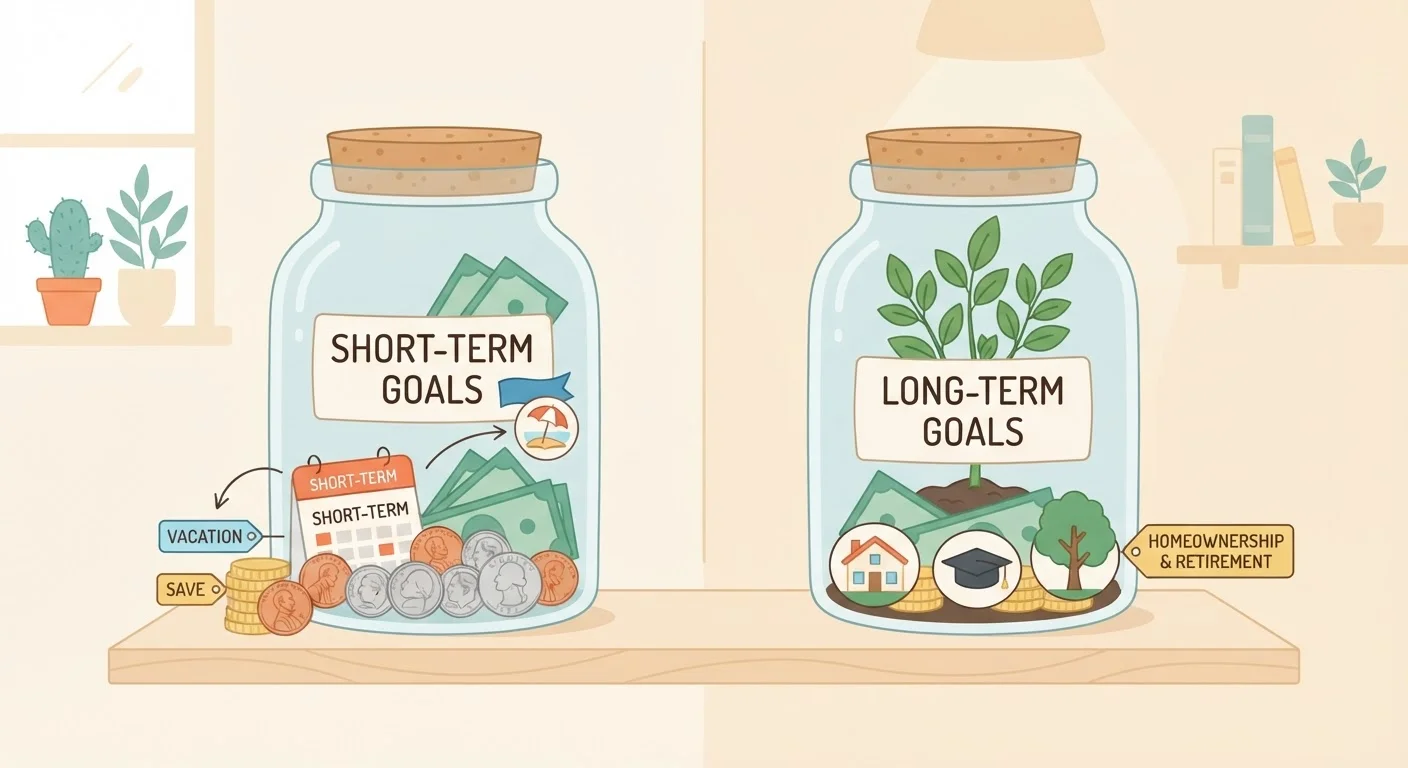
Some HYSAs have minimum balance requirements or charge fees if a balance drops below a threshold. Always review the fee schedule and terms before opening any account. If you're trying to match the right account to the right goal, short-term vs. long-term savings goals is a useful framework to consider alongside your account choice.
One practical strategy: keep a small traditional savings account linked to your checking for day-to-day overflow, while parking your larger emergency fund or goal-based savings in a HYSA where the interest compounds faster. You can even automate transfers into each account to remove the friction of manually moving money.
This article is for general informational and educational purposes only and does not constitute personalized financial advice. Consult a qualified financial professional for guidance specific to your situation.