
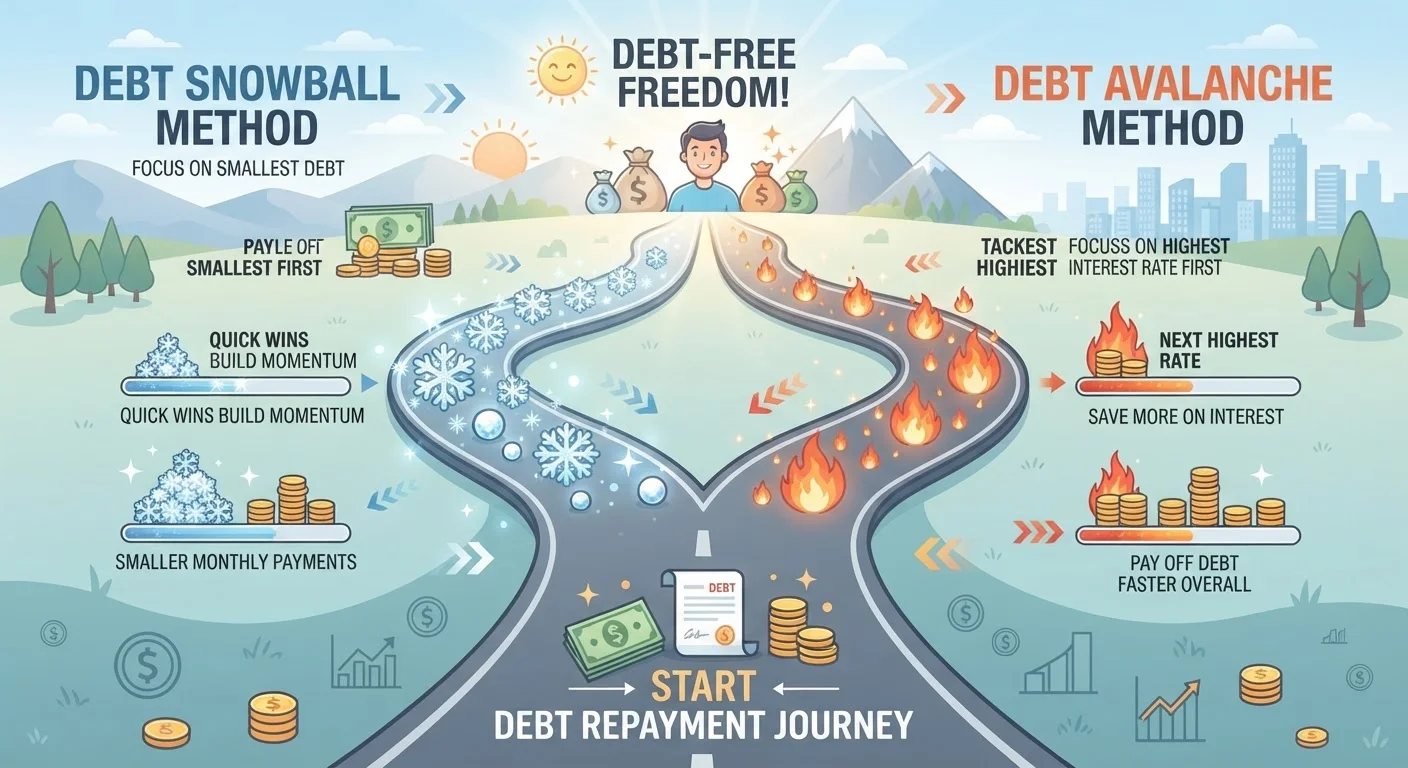
How Each Strategy Works
Both the debt avalanche and the debt snowball share the same core mechanic: you make minimum payments on every debt you owe, then direct any extra money toward one specific target account. Where they differ is in how you choose that target.
Debt Avalanche: You rank your debts from highest to lowest interest rate. Your extra dollars go to the highest-rate balance first. Once it's paid off, you roll that freed-up payment amount onto the next-highest-rate balance - and so on down the list.
Debt Snowball: You rank your debts from smallest to largest balance, ignoring interest rates. Your extra money goes to the smallest balance first. When it's gone, you roll that payment amount onto the next-smallest balance, gradually building a larger payment force - like a snowball rolling downhill.
Neither method requires you to earn more or spend less than you already do (though doing so accelerates either approach). Both work by concentrating repayment energy rather than spreading it thin. Before deciding between them, it helps to understand what types of debt you're dealing with, since the nature of each debt can affect your overall strategy.
| Criterion | Debt Avalanche | Debt Snowball |
|---|---|---|
| Payoff order | Highest interest rate first | Smallest balance first |
| Total interest paid | Generally lower | Generally higher |
| Time to first payoff | Potentially longer | Typically faster |
| Motivational structure | Math-driven progress | Milestone-driven progress |
| Best for | Disciplined, analytical savers | Motivation-dependent planners |
| Risk of abandonment | Higher if first target is large | Lower due to early wins |
The Real Cost Difference
The avalanche wins on pure math. By eliminating high-interest balances first, you reduce the amount of principal that accumulates costly interest charges. Over several years of repayment, this difference can be meaningful - potentially hundreds to thousands of dollars depending on your rates and balances.
The snowball, by contrast, may leave a high-interest debt active longer while you clear smaller ones. That means more interest accruing on that balance during the months you're focused elsewhere.
~$1,000+
Potential interest savings with avalanche vs. snowball
Illustrative estimates vary widely by balance size and rate spread; individual outcomes depend entirely on specific debt amounts, rates, and payment levels.
77%
Americans who carry some form of debt
According to Experian's State of Credit report, the majority of U.S. consumers hold at least one form of outstanding debt obligation.
However, the practical gap between the two strategies depends on your specific debts. If your interest rates are clustered closely together, the cost difference shrinks considerably. If you have one outlier - say, a credit card at 26% APR alongside others at 18% - the avalanche's advantage becomes more pronounced.
It's also worth noting that neither strategy exists in a vacuum. If you're carrying multiple types of debt and considering simplification, reviewing what debt consolidation can and can't do may be worthwhile before committing to either payoff sequence.
The Psychology Behind Each Method
Financial behavior research consistently shows that motivation and follow-through are major variables in debt repayment success - often more impactful than the technical efficiency of any given plan. The snowball method was designed with this in mind.
When you eliminate a debt entirely, you experience a concrete sense of closure. You have one fewer bill, one fewer minimum payment to juggle. That feeling of progress - even on a small account - can reinforce the habit of making extra payments and sustain your commitment through the long middle stretch of payoff.
The avalanche, by contrast, can feel slow at first, especially if your highest-interest debt also carries a large balance. You may be making progress every month without seeing a single account reach zero for a long time. For some people, that's fine - the math keeps them motivated. For others, it leads to discouragement and abandonment of the plan altogether.
Neither response is a character flaw. Knowing which type of person you are is genuinely useful information when selecting a strategy. A plan you stick with for three years will outperform a theoretically superior plan you abandon after six months.
You Don't Have to Choose Perfectly
Some people use a hybrid approach: they knock out one or two very small balances quickly for the psychological boost, then switch to avalanche order for the remaining debts. This isn't a textbook method, but it reflects how real motivation works. The most important factor is that you choose a plan, understand it clearly, and execute it consistently - not that you optimize every variable perfectly from the start.
Choosing the Right Fit - and What Comes After
Ask yourself honestly: Do I need to see fast results to stay motivated, or can I trust a slower process if I know it's working? If early wins are what keeps you going, the snowball is likely the better operational choice for you - even if it's not the cheapest. If you're analytically driven and can track interest savings as a form of progress, the avalanche may suit you better.
A few practical questions can also sharpen your decision:
- Are any of your debts close to their credit limit? Paying those down may also improve your credit utilization ratio.
- Do you have any small balances you could eliminate quickly regardless of rate? That's snowball logic applied narrowly.
- Is there a single debt with an unusually high rate that dwarfs the others? That argues for avalanche targeting.
Once you've cleared your debts, the work isn't entirely over. Building habits that prevent balances from creeping back up is its own challenge - see how to keep credit card debt from coming back for practical guidance. And if you want to make sure your payoff effort fits into a broader money management approach, exploring how paying yourself first compares to traditional budgeting can help you build a more complete financial framework.
This article is for general informational and educational purposes only and does not constitute personalized financial or legal advice. Consult a qualified financial professional for guidance specific to your circumstances.