Why the Exchange Method Matters
Most travelers treat currency exchange as an afterthought - something to handle at the airport right before boarding. That impulse is understandable but costly. The difference between a favorable and an unfavorable exchange rate can amount to $10-$30 or more per $100 exchanged, depending on the provider and destination. On a two-week trip with meaningful cash spending, those differences compound quickly.
The core issue is that currency exchange is a commercial transaction, and every provider builds in a margin. That margin - sometimes called a spread - is the gap between the mid-market rate (the rate banks use when trading with each other) and the rate offered to consumers. Fees and commissions sit on top of that. Understanding where each option sits on the cost-versus-convenience spectrum helps you make a more deliberate choice. See the broader international trip planning guide for context on where currency fits into your overall prep.
Airport Kiosks: Maximum Convenience, Maximum Cost
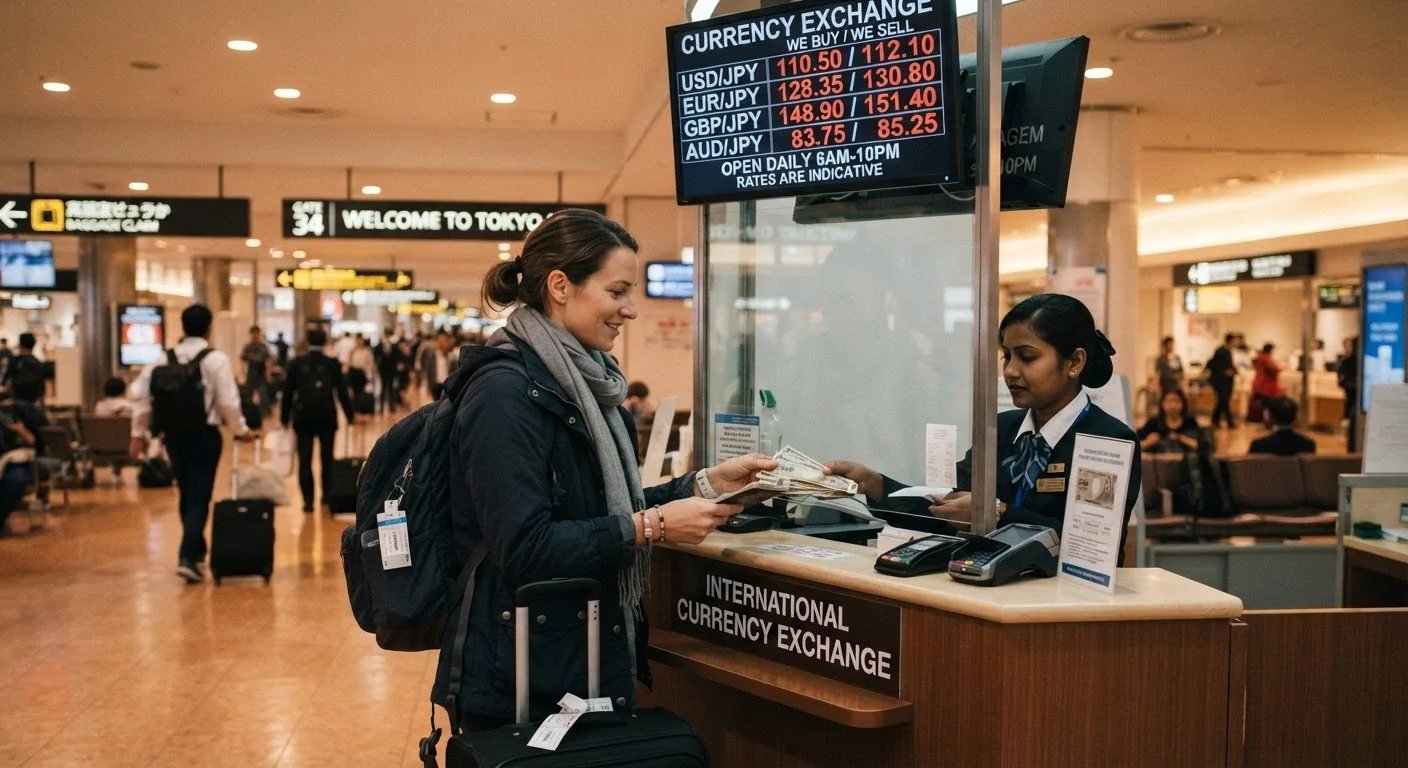
Airport currency exchange kiosks - operated by companies that lease terminal space - are designed for one thing: capturing travelers at their most pressed for time. Rates at these kiosks typically carry spreads of 10-15% above mid-market, and some locations also charge a flat transaction fee. A prominently displayed "no commission" sign doesn't mean a competitive rate; the margin is baked into the exchange rate itself.
That said, kiosks serve a legitimate purpose. If you land with zero local currency and need cash for a taxi, transit card, or tipping immediately, a kiosk solves an immediate problem. The practical approach: limit any airport kiosk exchange to the smallest amount you need to get to your first destination, then source better rates once you're settled.
Decline Dynamic Currency Conversion
When an ATM or payment terminal abroad offers to charge you in U.S. dollars instead of local currency, always choose local currency. Dynamic currency conversion lets the merchant or ATM operator set the exchange rate, which is almost always worse than the rate your U.S. bank or card network would apply. This applies at ATMs, hotel checkouts, and point-of-sale terminals.
Arrivals-hall kiosks at your home airport before departure are generally no better than those at your destination. If you're going to use a kiosk at all, doing so abroad rather than at home at least saves you from carrying foreign cash on the outbound flight.
Bank Branches and Credit Unions: Best Rates, Least Flexible
Ordering foreign currency through your home bank or credit union - either in-branch or online for pickup - typically yields rates significantly closer to mid-market than kiosks do. Many banks waive or reduce the transaction fee for account holders. The catch is lead time: most branches require 3-7 business days to obtain less common currencies, though major currencies (euros, British pounds, Japanese yen, Canadian dollars) are often available sooner.
This option works best when you know in advance how much cash you'll need and are traveling to a destination where ATM access may be unreliable or where card acceptance is limited. It's less suited to spontaneous travel or trips where spending patterns are hard to predict - unused foreign currency needs to be exchanged back, incurring another round of spread costs.
| Airport Kiosks | Home Bank/Credit Union | ATMs Abroad | |
|---|---|---|---|
| Exchange rate quality | Poor (10-15% spread) | Good (close to mid-market) | Good (near interbank rate) |
| Fees | High; sometimes flat fee added | Low to none for account holders | Foreign transaction + ATM operator fees |
| Convenience | Very high - available immediately | Low - requires advance planning | High - available on arrival |
| Advance notice required | None | 3-7 business days | None |
| Best amount to exchange | Small emergency amounts only | Larger, pre-planned sums | Moderate, as needed |
| Risk of unused currency | Low (small amounts) | Higher (pre-ordered sum) | Low (withdraw as needed) |
ATMs Abroad: The Practical Default for Most Travelers
Withdrawing local currency from an ATM at your destination is the approach most experienced international travelers rely on. Network ATMs - those on Visa/Plus, Mastercard/Cirrus, or similar international networks - apply the wholesale interbank exchange rate, which is far closer to mid-market than retail exchange counters. The costs to watch are: your U.S. bank's foreign transaction fee (typically 1-3%), your bank's out-of-network ATM fee (often $3-5 flat), and the foreign ATM operator's own fee.
Some U.S. checking accounts are specifically designed to reimburse foreign ATM fees or waive foreign transaction charges - worth investigating before you travel. When an ATM abroad prompts you to pay in U.S. dollars rather than local currency, decline. This option - called dynamic currency conversion - shifts the exchange rate control to the ATM operator, almost always at a worse rate than your bank would apply.
For a broader pre-departure checklist that includes setting up your banking access, see the practical arrival checklist for first-time international travelers.
Check Your Card's Fee Structure Before You Go
Not all debit cards behave the same abroad. Contact your bank before departure to confirm whether foreign transaction fees apply and whether ATM fees are reimbursed. Some accounts designed for travelers offer both benefits automatically, which can meaningfully reduce the cost of ATM-based currency access over a multi-week trip.
ATMs in airports and tourist-heavy zones often charge higher operator fees than machines at local bank branches. If you can wait until you're away from the terminal, withdrawing from a bank-branded ATM in the city typically reduces operator fees.
Practical Strategy: Combining Methods
A layered approach minimizes both cost and risk. Before departure: order a modest amount of the destination currency from your bank - enough to cover ground transportation and the first night. Abroad: use a low-fee debit card at reputable bank ATMs for the bulk of your cash needs. Keep a credit card with no foreign transaction fee for larger purchases where cards are accepted.
Destinations vary considerably in cash culture. Some European cities are increasingly cashless; parts of Southeast Asia and many rural areas worldwide remain heavily cash-dependent. Researching this before you leave helps you calibrate how much to pre-exchange versus withdraw on arrival. The guide to staying connected abroad pairs well with this planning step, since mobile data makes it easier to locate ATMs and check your account while traveling.
Exchange rates, fees, and ATM availability vary by destination and financial institution. Verify current terms with your bank and check travel advisories before your trip.