
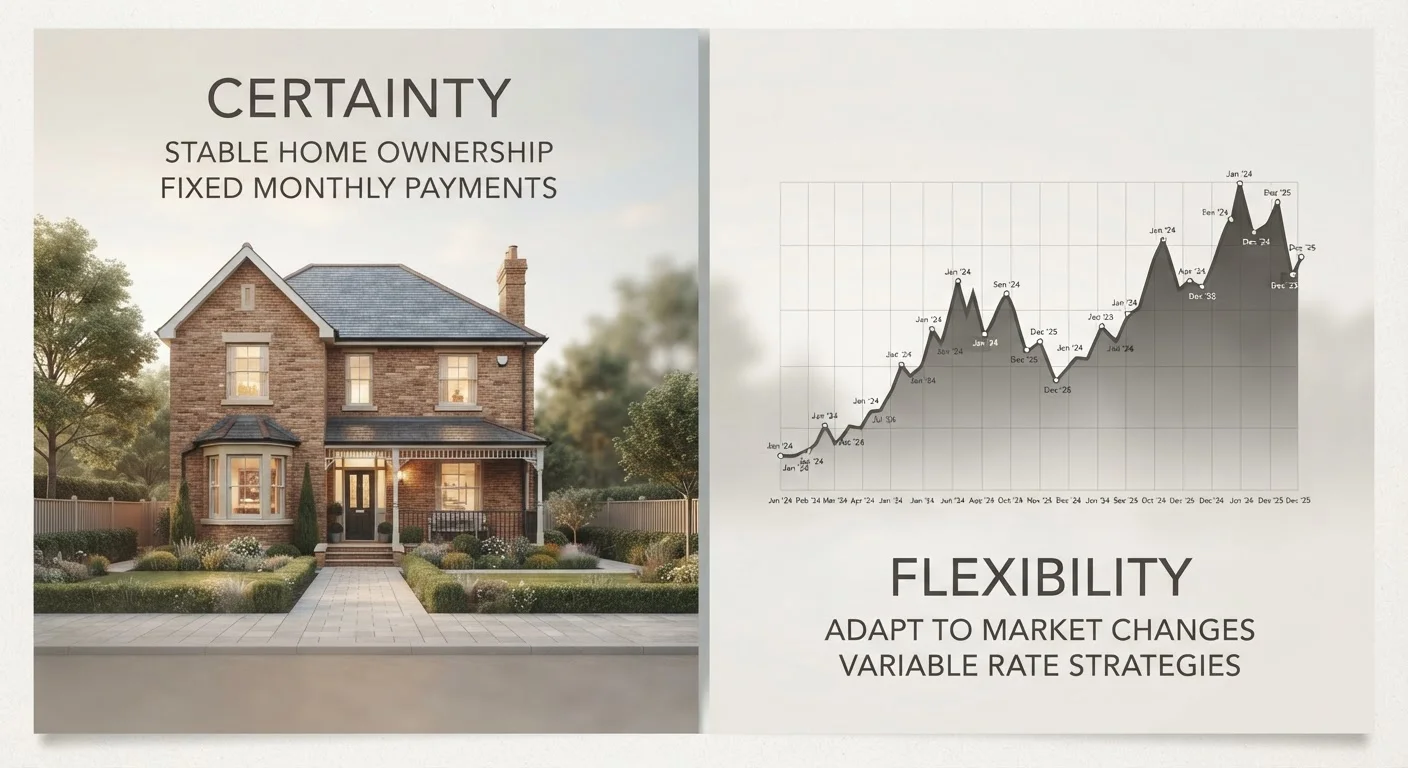
How Each Mortgage Structure Works
A fixed-rate mortgage sets your interest rate at closing, and that rate remains unchanged for the life of the loan - typically 15 or 30 years. Your principal and interest payment stays constant every month, making it straightforward to plan long-term household finances. Understanding how fixed versus variable expenses behave is helpful context here: a fixed mortgage payment functions exactly like any other fixed cost in your budget.
An adjustable-rate mortgage (ARM) begins with a fixed introductory period - commonly five, seven, or ten years - during which the rate does not change. After that period ends, the rate adjusts at regular intervals (often annually) based on a benchmark index, such as the Secured Overnight Financing Rate (SOFR), plus a lender margin. ARMs include caps that limit how much the rate can increase per adjustment and over the life of the loan, but payments can still rise meaningfully if market rates climb.
| Criterion | Fixed-Rate Mortgage | Adjustable-Rate Mortgage (ARM) |
|---|---|---|
| Interest rate | Locked for the full loan term | Fixed initially, then adjusts periodically |
| Initial monthly payment | Typically higher at current rates | Typically lower during intro period |
| Payment predictability | Completely predictable | Uncertain after adjustment period |
| Rate risk | None - insulated from market moves | Rate can rise after intro period |
| Best ownership horizon | Long-term (10+ years) | Short-to-medium term (under 7 years) |
| Refinancing need | Less urgent | Often desirable before adjustments begin |
| Budgeting complexity | Low - payment is fixed | Higher - future payments uncertain |
Key Financial Trade-Offs
The most immediate difference most borrowers notice is the starting rate. ARMs historically carry lower initial rates than comparable fixed-rate loans, which translates into lower monthly payments during the introductory period. That gap can be meaningful - particularly for buyers stretching to qualify in a competitive market - but it narrows or reverses if rates rise after the adjustment period begins.
Fixed-rate loans cost more in the early years but provide complete insulation from rate volatility. For buyers planning to own their home for decades, this certainty often outweighs the short-term savings an ARM offers. As rising interest rates reshape purchasing power and monthly costs, the value of locking in a rate before further increases can be substantial - though future rate movements are never predictable.
30 years
Most common fixed-rate mortgage term
The 30-year fixed-rate mortgage remains the most widely used home loan structure in the United States, according to Freddie Mac data.
5/1, 7/1, 10/1
Most common ARM introductory structures
These ARM formats - meaning five, seven, or ten fixed years followed by annual adjustments - represent the majority of adjustable-rate products offered by U.S. lenders.
2%/6%
Typical ARM periodic/lifetime rate caps
Many standard ARMs include a 2% annual adjustment cap and a 6% lifetime cap above the initial rate, though terms vary by lender and product.
Total interest paid over the life of the loan is another dimension worth modeling. A fixed-rate borrower knows this figure from day one. An ARM borrower's total cost depends on how rates move - a genuine unknown. Both structures are legitimate tools; neither is universally superior.
When Your Timeline Changes the Calculation
Expected time in the home is arguably the most important variable in this decision. If you are confident you will sell or refinance before the ARM's fixed period expires, the rate risk largely stays theoretical - you exit before adjustments begin. In that scenario, the lower initial rate represents real savings with limited downside exposure.
If your plans are uncertain or you intend to stay long-term, the calculus shifts. Life circumstances change, and locking yourself into an ARM with the assumption you will move in five years carries genuine financial risk if those plans don't materialize. For buyers weighing the broader decision of whether homeownership makes sense at all right now, a realistic comparison of renting versus buying costs can add useful context before committing to any mortgage structure.
ARM Rate Caps: What They Actually Limit
Adjustable-rate mortgages include built-in caps that restrict how sharply the rate can move. A typical structure might cap any single adjustment at 2 percentage points and the total lifetime increase at 6 percentage points above the starting rate. However, even capped increases can translate into hundreds of dollars in additional monthly payments. Always ask a lender to show you worst-case payment scenarios based on your specific ARM's cap structure before signing.
Most financial professionals suggest stress-testing your budget against potential ARM payment increases before choosing that route - ensuring you could absorb higher payments if rates rise and your plans change.
This article is for general informational purposes only and does not constitute personalized financial or mortgage advice. Consult a licensed mortgage professional or financial adviser regarding decisions specific to your circumstances.