What Sets These Two Flooring Types Apart
Despite looking nearly identical once laid, engineered hardwood and solid hardwood are built in fundamentally different ways - and those differences determine where and how well each performs in your home.
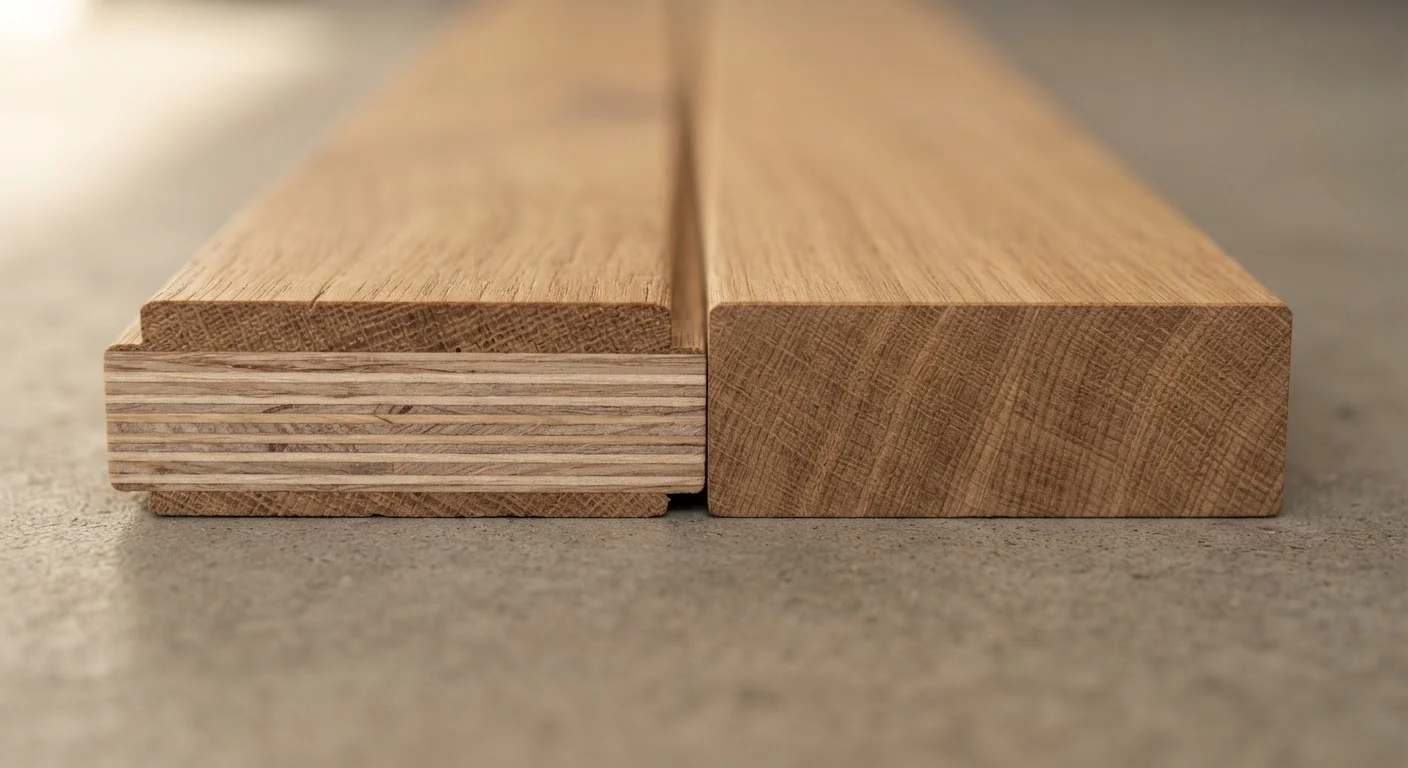
Solid hardwood is exactly what it sounds like: a single, uniform piece of milled wood from top to bottom, typically 3/4 inch thick. Species like oak, maple, hickory, and walnut are common choices. Because it's pure wood throughout, it responds readily to changes in humidity - expanding when moist and contracting when dry. This sensitivity limits where it can be installed.
Engineered hardwood is constructed differently. A real wood veneer - usually 2-6 mm thick - is bonded to a core of cross-layered plywood or high-density fiberboard (HDF). Those alternating grain directions counteract wood's natural tendency to move with humidity, giving engineered planks far greater dimensional stability. The surface looks and feels like real wood because it is real wood.
| Criterion | Engineered Hardwood | Solid Hardwood |
|---|---|---|
| Construction | Real wood veneer over plywood core | Single solid wood plank throughout |
| Moisture resistance | Good - stable in humidity fluctuations | Poor - expands and contracts significantly |
| Installation locations | Above, on, and below grade | Above grade only |
| Refinishing potential | 1-3 times (veneer-dependent) | 3-5+ times over lifespan |
| DIY-friendly installation | Yes - floating/click-lock options available | Mostly no - requires nail-down, wood subfloor |
| Radiant heat compatibility | Generally yes - check product specs | Generally no - manufacturer-dependent |
| Typical plank thickness | 3/8 inch to 9/16 inch | 3/4 inch standard |
Where Each Floor Can Be Installed
Installation location is one of the most practical decision points between these two flooring types. Solid hardwood is generally suited only to above-grade spaces - that means any floor that sits above ground level, such as a first- or second-story living area. Manufacturers typically advise against installing it in basements or directly over concrete slabs, because moisture wicking up through concrete can cause cupping, warping, or gapping.
Engineered hardwood, by contrast, can be installed at grade, above grade, or below grade (in most cases), making it the practical choice for basements and slab-on-grade homes common in warmer US climates. It can be glued down, nailed, stapled, or floated depending on the subfloor and product specification - always check the manufacturer's installation guidelines, as they vary.
A Note on Moisture Testing
Before installing either floor type, test your subfloor's moisture content using a moisture meter - a standard tool available at most hardware stores. Concrete slabs should typically read below 3 lbs per 1,000 sq ft using the calcium chloride test method, though product specifications vary. Skipping this step is one of the most common causes of premature flooring failure.
Neither type should be installed in areas of standing water risk, such as bathrooms or unfinished laundry rooms. Area rugs and moisture barriers still play an important protective role regardless of which product you choose.
Refinishing, Durability, and Long-Term Value
One of the clearest advantages of solid hardwood is refinishability. Because the plank is solid wood throughout, it can be sanded down and refinished multiple times - often three to five or more cycles over its lifetime. This means scratches, dents, and fading from foot traffic or sunlight can be periodically renewed, extending the floor's life well beyond 50 years with proper care.
Engineered hardwood can also be refinished, but the number of times depends on the thickness of its veneer layer. Thinner veneer products (around 2 mm) may only withstand one light sanding, while thicker veneer options (5-6 mm) may allow two to three refinishing cycles. When evaluating engineered products, ask specifically about the wear layer thickness - this directly dictates long-term performance.
3-5+
Refinishing cycles for solid hardwood
Industry flooring guides generally indicate solid 3/4-inch hardwood can withstand multiple sanding cycles, supporting a lifespan of 50-100 years with maintenance.
2-6 mm
Engineered hardwood veneer thickness range
Veneer thickness varies by product line and directly determines how many times an engineered floor can be sanded and refinished over its life.
From a day-to-day durability standpoint, the hardness of the top wood species matters more than the construction type. A harder species like hickory or white oak will resist surface dents better than a softer species like pine, regardless of whether it's engineered or solid.
Installation Costs and DIY Considerations
Both flooring types require careful subfloor preparation - flatness, dryness, and structural integrity are non-negotiable starting points. Beyond that, costs and installation complexity diverge.
Solid hardwood installation is almost always a nail-down or staple-down process requiring a wood subfloor and pneumatic flooring nailers. Concrete subfloors are not compatible, and the process benefits significantly from professional experience. Acclimating solid planks to your home's humidity for 3-5 days before installation is standard practice.
Engineered hardwood offers more installation flexibility. Floating installations using click-lock profiles can be a manageable DIY project for experienced homeowners. Glue-down methods over concrete are also common, though they're more involved. Either way, acclimation is still recommended - typically 48-72 hours, per most manufacturer guidelines.
Material costs for both types vary widely based on wood species, grade, and plank dimensions. Engineered products tend to have a broader price range overall. For any installation covering a significant area - or involving subfloor repairs, transitions, or radiant heat - consulting a licensed flooring contractor is worthwhile before committing to either product.
This article is for general informational and educational purposes. Costs, performance, and installation requirements vary by product, region, and home conditions. Always consult manufacturer specifications and, where appropriate, a qualified flooring professional before beginning a project.