
Why Good Intentions Alone Don't Create Habits
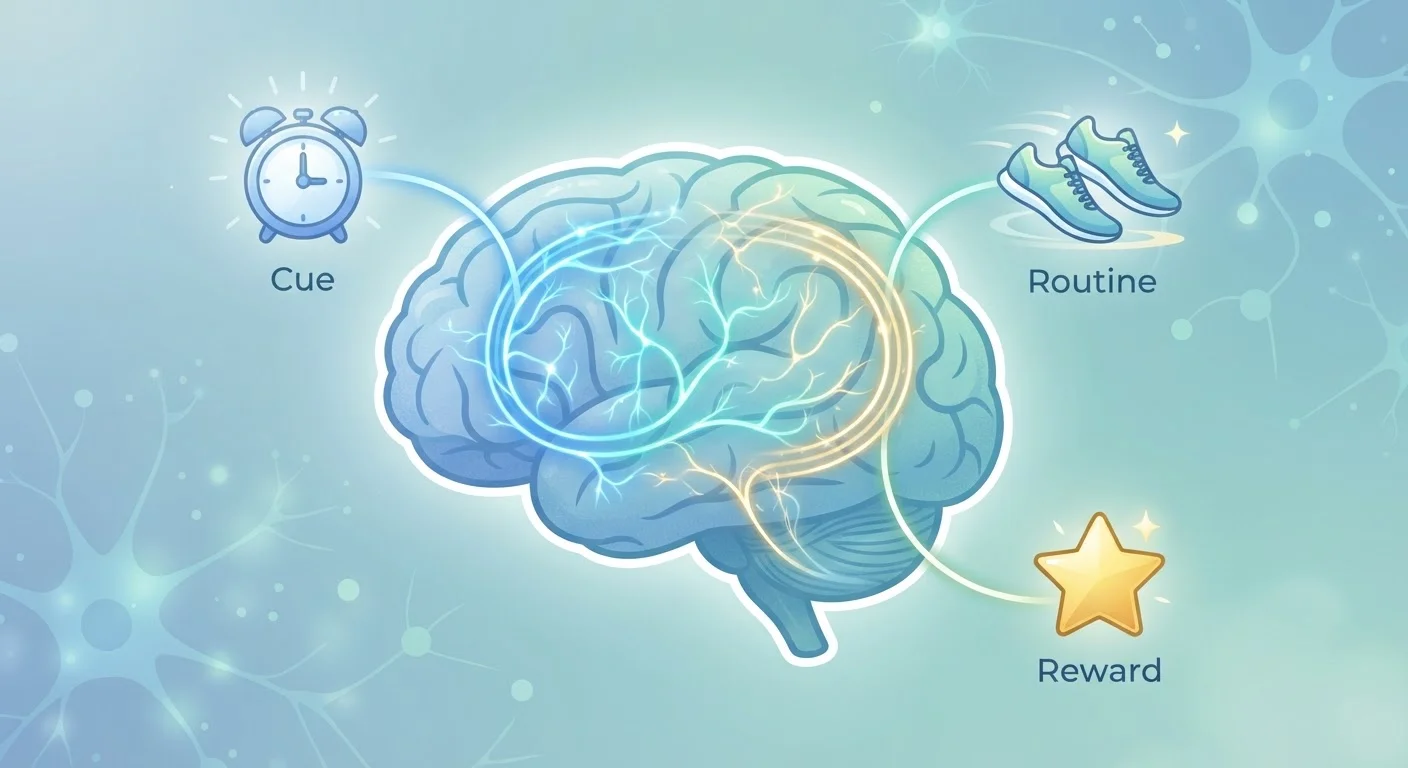
Most people assume a healthy habit fails because they lack discipline or willpower. Behavioral science tells a different story. Habits are not primarily about character - they're about systems. Specifically, they depend on a repeating loop of cue, routine, and reward that the brain can automate over time.
When that loop is missing or inconsistent, the behavior stays in the realm of conscious effort - something you have to decide to do each day. That's exhausting, and over time, it loses to the competing demands of daily life. Understanding where the loop breaks down is the first step toward building something that actually sticks.
66 days
Average time to form a new habit
A widely cited study published in the European Journal of Social Psychology found habit automaticity took an average of 66 days, ranging from 18 to 254 days depending on complexity.
~40%
Daily behaviors that are habitual
Research from Duke University suggests that roughly 40 percent of daily actions are habits rather than conscious decisions, highlighting how much behavior runs on autopilot.
The Most Common Habit Mistakes - and How to Fix Them
The following mistakes appear repeatedly in behavioral research and clinical practice. Recognizing them in your own attempts can help you restructure your approach rather than simply trying harder.
Starting with a goal that's too large or ambitious for your current routine.
Why it happens: Motivation spikes at the start of a new effort, making big commitments feel realistic. People overestimate how much willpower they'll sustain across weeks.
Relying on motivation rather than environmental design to maintain the behavior.
Why it happens: Motivation feels powerful at first, so people assume it will carry them. In reality, motivation fluctuates daily based on sleep, stress, and mood.
Skipping a consistent time or context anchor for the new behavior.
Why it happens: People plan to do the habit "when they have time," but unscheduled intentions compete with dozens of daily demands.
Treating a missed day as evidence the habit has failed.
Why it happens: An all-or-nothing mindset frames any lapse as total failure, which often becomes a self-fulfilling prophecy.
Focusing only on the outcome rather than building an identity around the behavior.
Why it happens: People frame habits as things they're doing to achieve something ("I want to lose weight") rather than who they're becoming ("I'm someone who moves every day").
If you're working on a nutrition-related habit specifically, the same principles apply - start small and anchor behavior to existing moments. See small nutrition habits backed by consistent evidence for practical, research-supported examples.
Building Sustainable Habits in Real Life
This Is Information, Not Medical Advice
The content in this article is general health and behavioral education. It is not a substitute for guidance from a qualified healthcare provider. If you have a medical condition or are planning significant lifestyle changes, consult a licensed health professional first.
Sustainable habits are ones that survive disruption - a work deadline, a sick child, a week of poor sleep. The mistake most people make is designing for ideal conditions. Instead, plan explicitly for friction: What's the minimum version of this habit you can do on a terrible day? That floor, not your ceiling, is what determines long-term success.
Perfectionism Can Derail Real Progress
Expecting a flawless streak from day one sets up an all-or-nothing mindset. Research in behavioral science consistently shows that one missed day rarely predicts failure - but the decision to quit after missing a day often does. Building resilience into your approach is as important as the habit itself.
For those building a movement habit from zero, a structured starting point can reduce overwhelm. A day-by-day framework for starting an exercise habit walks through exactly this approach. And if irregular schedules disrupt sleep consistency - itself a major factor in willpower and behavior change - strategies for anchoring your sleep routine can help.
This article is for general informational and educational purposes only and does not constitute medical advice. Always consult a qualified healthcare professional before making significant changes to your health routines.