
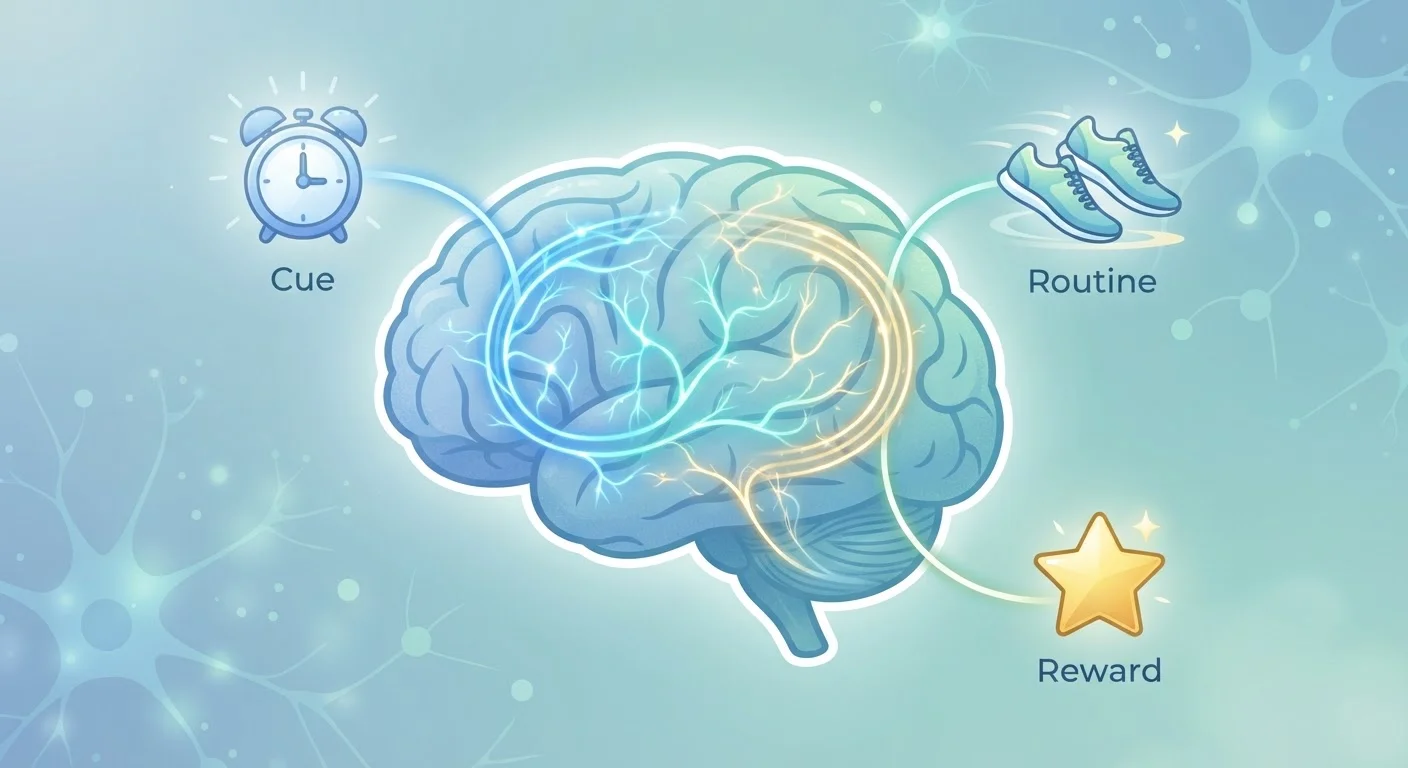
Why Your Brain Loves Habits
Your brain is constantly looking for ways to conserve energy. Deliberate thinking - weighing options, making decisions, resisting impulses - is metabolically expensive. Habits are the brain's solution to this problem: by automating frequently repeated sequences of behavior, the brain frees up cognitive resources for tasks that actually require conscious attention.
This automation process is driven largely by the basal ganglia, a set of structures deep in the brain involved in procedural learning. When you repeat a behavior consistently in response to a specific trigger, the basal ganglia begins to package it as a single, efficient unit. Over time, executing that behavior demands almost no conscious thought - it simply runs. This is why experienced drivers can navigate a familiar route while holding a conversation, or why you reach for your phone without deciding to.
Understanding this process isn't just academically interesting. It gives you practical leverage. Once you know how the loop is built, you can build it intentionally - or disrupt it deliberately. See our exploration of behavioral science behind habit formation for a deeper look at what keeps people stuck.
The Three Components: Cue, Routine, Reward
Behavioral scientists, drawing on decades of research into how habits are encoded in the brain, describe the habit loop as having three essential components.
The Cue
A cue is any trigger that signals the brain to initiate a habitual behavior. Cues can be a time of day, a location, an emotional state, the presence of other people, or an immediately preceding action. For example, sitting down at your desk might be the cue that automatically launches a coffee-making routine.
The Routine
The routine is the behavior itself - the action sequence the brain has automated. It can be physical (lacing up running shoes), mental (running through a mental checklist), or emotional. The routine is the most visible part of the loop but is rarely the most powerful driver of it.
The Reward
The reward is what tells the brain the loop is worth remembering. It satisfies a craving that the cue has sparked. Rewards can be physiological (a caffeine rush), psychological (a sense of accomplishment), or social (positive feedback from others). When the reward is immediate and meaningful, the brain encodes the loop more strongly, increasing the likelihood the behavior will repeat.
40-45%
Daily behaviors that are habitual
Research by behavioral scientists at Duke University estimates that nearly half of everyday human actions are habits rather than conscious decisions.
66 days
Average time to form a new habit
A 2010 study in the European Journal of Social Psychology found the average time for a new behavior to become automatic was 66 days, with a range of 18 to 254 days.
3x
Greater success with implementation intentions
Studies on implementation intentions - pre-deciding the cue and context for a new habit - show substantially higher follow-through compared to motivation-only approaches.
How to Use the Habit Loop Intentionally
Knowing the structure of a habit loop lets you engineer new behaviors with more precision. Rather than relying on willpower alone - a finite resource - you can design the environment and sequence to work in your favor.
Start with a reliable cue. Choose a cue that already happens consistently in your day. Attaching a new routine to an existing, stable trigger - a practice sometimes called habit stacking - increases the chance the new behavior will fire automatically over time.
Keep the routine small at first. The smaller the initial routine, the lower the activation energy required. A two-minute version of your intended habit is far easier to start and repeat than an ambitious version. Consistency builds the loop; complexity can come later. This principle applies whether you're working on building a walking habit or establishing a consistent evening wind-down.
Engineer an immediate reward. If the natural reward is delayed - as with most health behaviors - you may need to add one. This could be as simple as tracking your streak, playing a favorite song during the routine, or pairing it with something you enjoy.
Pair New Habits With Existing Ones
Habit stacking - linking a new behavior to something you already do reliably - dramatically increases the odds of consistency. For example, if you want to build a brief mindfulness practice, attach it to an anchor habit like brewing morning coffee. The existing habit provides a built-in, reliable cue without requiring any extra environmental setup.
For readers building movement-based habits from the ground up, our day-by-day exercise habit framework applies these principles in a structured, accessible format.
Breaking Unhelpful Habit Loops
The same mechanism that makes habits useful also makes them persistent - including ones you'd rather not have. The basal ganglia does not distinguish between helpful and harmful routines; it encodes whatever is rewarded consistently. This is why willpower-only approaches to breaking habits tend to fail: they don't address the underlying loop.
A more effective strategy is routine substitution. Keep the cue and the reward, but insert a different routine in between. If scrolling social media is triggered by boredom (cue) and rewards you with novelty and stimulation (reward), replacing the scroll with a brief walk or a short podcast can satisfy a similar craving through a different behavior.
Identifying the craving beneath the reward is the key step. Ask: what does this routine actually give me? The answer is often stress relief, distraction, social connection, or a sense of control. Once you understand the craving, you can experiment with routines that satisfy it more constructively. This approach also applies to daily habits that support both physical and mental health.
This article is for general informational and educational purposes only and is not a substitute for professional medical or mental health advice. If you have concerns about compulsive behaviors or mental health, please consult a qualified healthcare professional.