What Happens to Your Brain in the Hour Before Sleep
The transition from wakefulness to sleep is a biological process, not simply the act of lying down and closing your eyes. In the hour before sleep, the brain begins producing melatonin - a hormone regulated by darkness - while cortisol levels gradually decline. The activities you choose during this window can either support or disrupt that process.
Screens and books engage the brain in measurably different ways. Understanding those differences helps explain why the same 30-minute pre-bed ritual can result in very different sleep outcomes. For a broader view of how evening habits shape health, see how morning and evening routines compare.
~90 min
Melatonin delay from evening blue light
Research from Harvard's Division of Sleep Medicine suggests blue light exposure can delay melatonin release by up to 90 minutes compared to dim light conditions.
68%
Stress reduction from six minutes of reading
A University of Sussex study found reading reduced physiological stress markers by up to 68% in just six minutes, outperforming other relaxation methods tested.
~3 hrs
Average daily screen time before bed (US adults)
Survey data from the American Academy of Sleep Medicine indicates many US adults spend several hours on devices in the evening hours before sleep.
The Science Behind Screen Time and Sleep Disruption
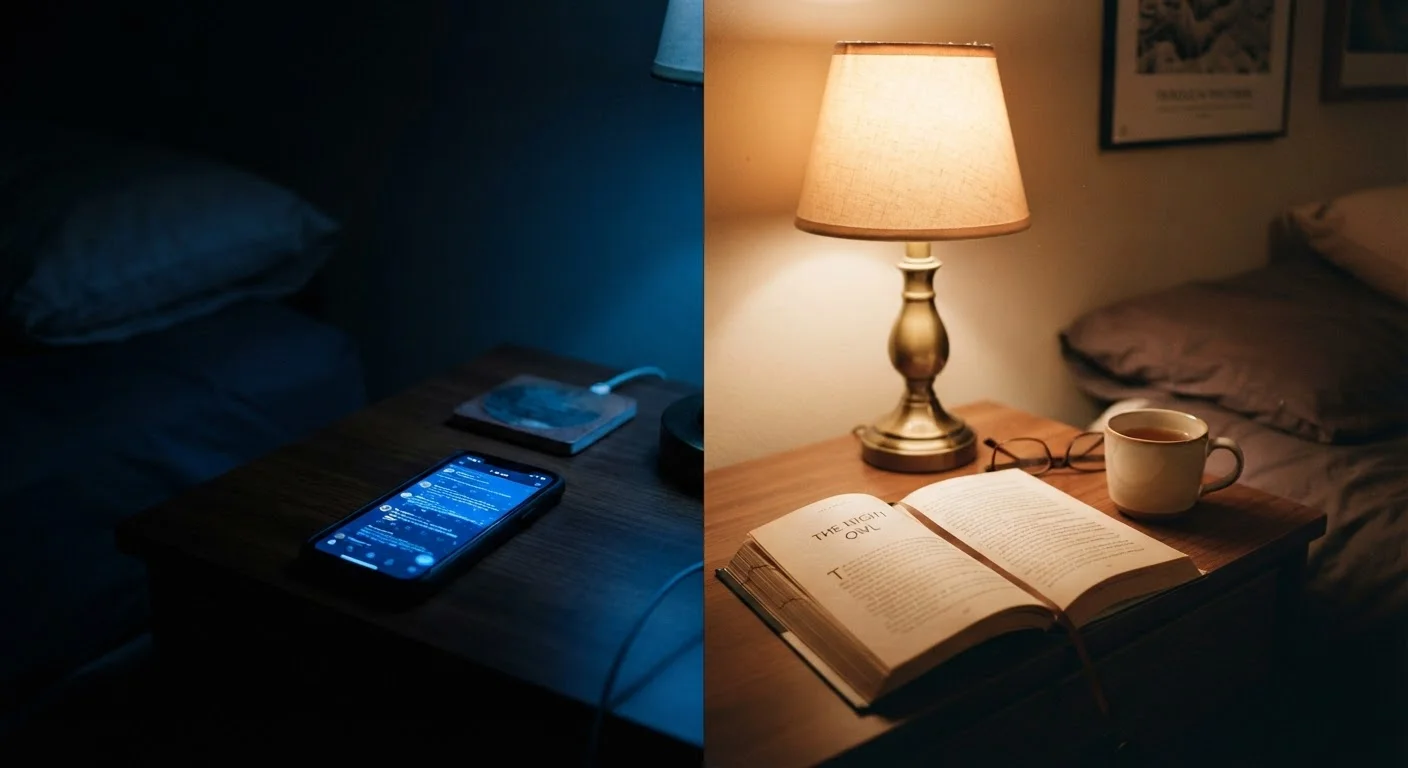
Smartphones, tablets, and televisions emit short-wavelength blue light - the same part of the light spectrum that sunlight uses to signal daytime alertness to your circadian system. Research published in peer-reviewed journals, including work from Harvard Medical School's Division of Sleep Medicine, has shown that exposure to blue light in the evening can suppress melatonin production and delay sleep onset. This connects directly to how natural light exposure during the day influences sleep hormones - both ends of the light spectrum matter.
Beyond the physiological effect, content is a significant factor. Social media feeds, news streams, and short-form video are engineered to capture attention and trigger emotional responses. This cognitive and emotional stimulation raises arousal, making it harder for the prefrontal cortex to downshift into the quieter, less reactive state associated with sleep readiness. Studies measuring sleep latency - the time it takes to fall asleep - consistently find longer delays among participants who used devices in the hour before bed compared to those who did not.
| Criterion | Screen Time Before Bed | Reading a Physical Book |
|---|---|---|
| Blue light exposure | High; suppresses melatonin | None from the book itself |
| Cognitive arousal | Often high, especially with social or news content | Low to moderate; narrative absorption aids wind-down |
| Sleep onset (latency) | Typically longer | Typically shorter |
| Melatonin suppression | Documented across multiple studies | Minimal under warm, dim lighting |
| Stress reduction | Variable; content-dependent | Associated with measurable stress reduction |
| Behavioral sleep cue | Weak; screens used at all hours | Strong when used consistently at bedtime |
| Accessibility | Very high; most adults own a device | High; libraries offer free access |
What Reading a Book Does Differently
A 2009 study conducted at the University of Sussex found that reading for as few as six minutes reduced participants' physiological stress markers - including heart rate and muscle tension - by up to 68%. While that research did not focus specifically on sleep, the relaxation response it describes is closely aligned with what sleep medicine specialists consider ideal pre-sleep conditions.
Physical books carry an additional advantage: they produce no light of their own. When read under a warm, low-intensity lamp, they avoid the blue-light suppression problem entirely. Narrative fiction, in particular, appears to facilitate a kind of productive mental absorption - the reader becomes engaged with another world, naturally releasing the rumination and mental rehearsal that often interfere with sleep.
Consistent pre-sleep reading also functions as a behavioral cue. Over time, the brain begins to associate the act of opening a book with the approach of sleep, reinforcing the routine. This aligns with the principles discussed in what a consistent sleep schedule does to your body.
A Direct Comparison: Screens vs. Books
The table below summarizes key differences between the two habits across dimensions that matter for sleep quality. Note that individual variation exists, and factors like screen brightness settings, content type, and reading duration all influence outcomes.
What About E-Readers and Night Mode?
E-readers like dedicated e-ink devices emit significantly less blue light than tablets or smartphones, and many include a warm-color night mode. Research suggests these adjustments reduce - but do not eliminate - blue light exposure. If a physical book is not practical, an e-reader in warm-light mode at low brightness is a meaningfully better option than a standard tablet or phone screen. Still, a printed book under a warm lamp remains the lowest-stimulation choice for pre-sleep reading.
If sleep difficulties persist despite changes to your pre-bed routine, it is important to speak with a qualified healthcare professional. Chronic insomnia and other sleep disorders have distinct causes and treatments that go beyond habit adjustment. For strategies on maintaining sleep hygiene across irregular schedules, building a consistent sleep routine when your schedule varies offers practical guidance.
This article is for general informational purposes only and does not constitute medical advice. Always consult a qualified healthcare professional for concerns about your sleep or overall health.