
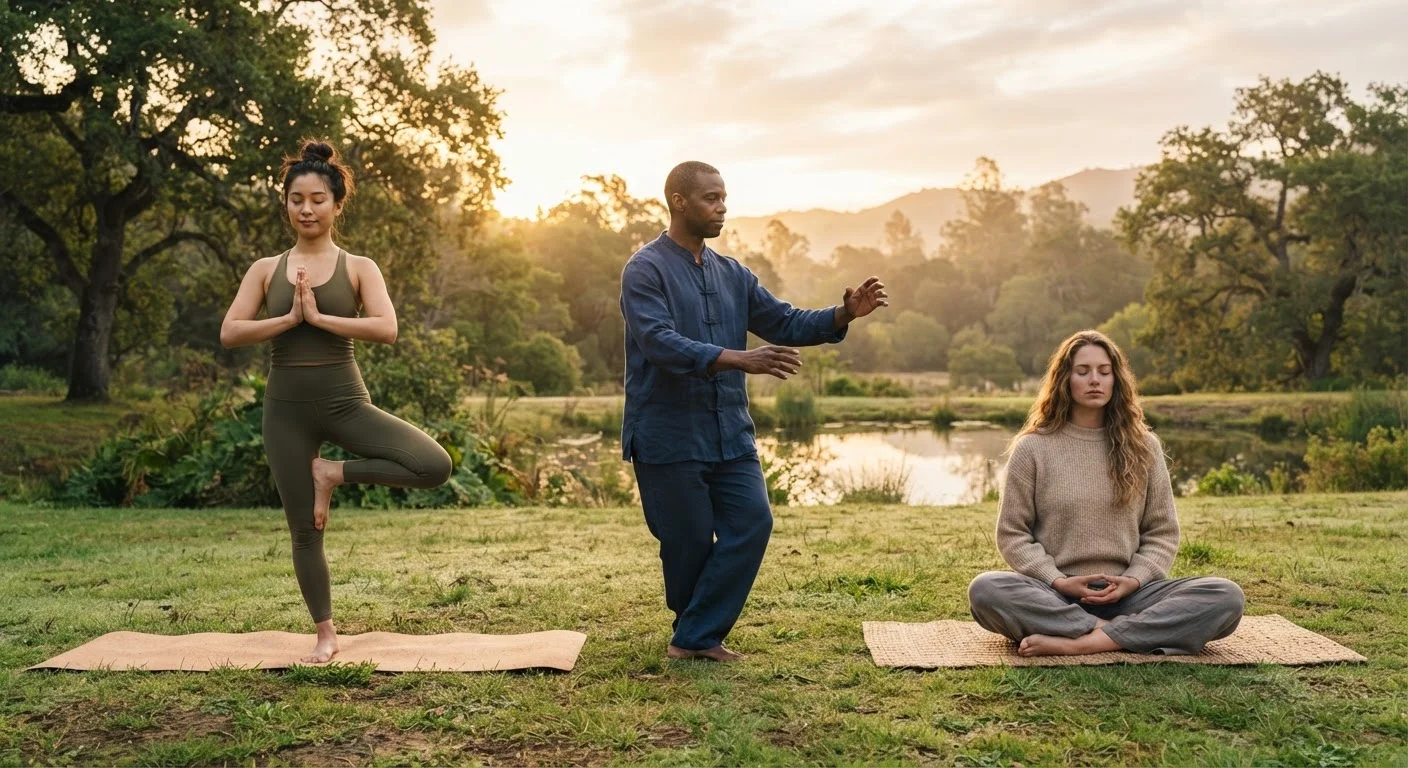
What Sets Each Practice Apart
All three practices sit under the broad umbrella of mind-body medicine - an approach recognizing that mental and physical health are deeply intertwined. Yet they arrive at that connection through very different routes.
Yoga originated in ancient India and has evolved into dozens of modern styles. Most involve a sequence of physical postures (asanas), coordinated breathwork (pranayama), and periods of stillness or meditation. The physical component ranges from gentle restorative sessions to vigorous, heat-building flows.
Tai chi is a Chinese martial art refined over centuries into a practice of slow, continuous movements performed in a meditative state. Unlike yoga, tai chi is almost always done standing and involves the whole body moving through choreographed sequences sometimes called "forms." Its low-impact nature has made it particularly popular among older adults.
Mindfulness meditation has roots in Buddhist traditions but is now widely studied and practiced in secular clinical settings. Rather than guiding the body through movement, it trains attention - typically by focusing on the breath, body sensations, or sounds - and observing thoughts without judgment. It can be practiced seated, lying down, or even while walking.
Understanding these foundations helps clarify why each practice produces somewhat different benefits and suits different people. For a broader look at how daily habits shape mental health, see everyday habits linked to emotional resilience.
What the Research Shows
The evidence base for all three practices has grown substantially over the past two decades, though research quality varies and no single study is definitive.
~40%
Reduction in anxiety symptoms
A meta-analysis published in JAMA Internal Medicine found mindfulness meditation programs associated with roughly a 0.38 standard deviation improvement in anxiety, comparable to moderate effect sizes.
~29%
Reduced fall risk in older adults
A Cochrane systematic review of tai chi trials in older adults reported an approximately 29% reduction in fall rate compared to controls.
Yoga: Multiple systematic reviews and meta-analyses have found yoga associated with reductions in perceived stress, symptoms of anxiety and depression, and improvements in sleep quality. Some studies also report modest benefits for blood pressure, chronic pain conditions, and inflammatory markers - though researchers note that study designs vary widely.
Tai chi: Research has consistently highlighted tai chi's benefits for balance and fall prevention in older adults, areas where the evidence is particularly strong. Studies also suggest improvements in cognitive function, blood pressure regulation, and quality of life in people with certain chronic conditions such as heart failure and arthritis.
Mindfulness meditation: Mindfulness-Based Stress Reduction (MBSR), an eight-week structured program, is among the most rigorously studied mind-body interventions. Evidence supports its role in reducing anxiety, depressive relapse, and chronic pain perception. Neuroimaging studies suggest regular practice is associated with changes in brain regions involved in attention and emotional regulation, though this research is still evolving.
Crucially, all three practices appear most effective when maintained consistently - occasional participation tends to yield fewer measurable benefits than a regular routine.
How They Compare: A Practical Overview
Choosing a practice often comes down to practical factors - physical ability, available time, cost, and personal preference - as much as the specific benefits each offers.
| Yoga | Tai Chi | Mindfulness Meditation | |
|---|---|---|---|
| Primary focus | Posture, breath, flexibility | Slow flowing movement, balance | Attention, present-moment awareness |
| Physical demand | Low to high (varies by style) | Low to moderate | Minimal |
| Equipment needed | Mat, comfortable clothing | Comfortable clothing only | None required |
| Instructor needed to start | Helpful but not essential | Recommended for form | Optional; apps and audio sufficient |
| Research-supported benefits | Stress, anxiety, flexibility, sleep | Balance, falls, blood pressure, cognition | Anxiety, depression, chronic pain, attention |
| Best-studied population | Broad adult population | Older adults, chronic conditions | Broad adult population |
| Average session length | 45-90 minutes (class) | 20-60 minutes | 10-45 minutes |
Yoga classes are widely available at gyms, studios, and community centers, and free or low-cost video resources are abundant. Tai chi is often taught at senior centers and community parks, though qualified instruction can be harder to find in some areas. Mindfulness meditation requires no equipment or dedicated space - apps, online programs, and in-person MBSR courses are all viable entry points.
Physical limitations matter, too. Tai chi's standing, low-impact format makes it broadly accessible, including for people with limited joint mobility. Yoga varies enormously by style - a gentle chair yoga class is very different from a vigorous vinyasa flow. Mindfulness meditation is the least physically demanding of the three, though sitting still for extended periods can itself be uncomfortable for some.
Try Before You Commit Long-Term
Most yoga studios and community centers offer introductory or drop-in sessions, making it easy to sample different styles or instructors. Many libraries and community organizations host free tai chi or meditation sessions as well. Sampling two or three options before settling on a regular practice can help you find one you'll actually maintain - consistency matters more than which practice you choose.
Integrating Mind-Body Practices Into Daily Life
There is no rule that limits a person to a single practice. Many people find that yoga supports their physical flexibility, tai chi refines their balance and coordination, and mindfulness meditation deepens their capacity to manage stress - and use all three in rotation or combination.
Starting small is generally more sustainable than attempting long daily sessions from the outset. Even brief, consistent engagement - ten to fifteen minutes of mindfulness practice, or a short sequence of tai chi movements in the morning - appears more beneficial than irregular marathon sessions, based on what behavioral research tells us about habit formation.
Community matters, too. Group yoga classes, tai chi sessions in a local park, or a meditation group can provide social connection alongside the practice itself, reinforcing long-term adherence. For a practical self-assessment of how mind-body habits fit into your overall daily routine, the Daily Wellbeing Habits self-check offers a useful starting framework.
This article is for general informational and educational purposes only and is not a substitute for professional medical advice, diagnosis, or treatment. Always consult a qualified healthcare provider before beginning a new physical or wellness practice, particularly if you have any existing health conditions.